
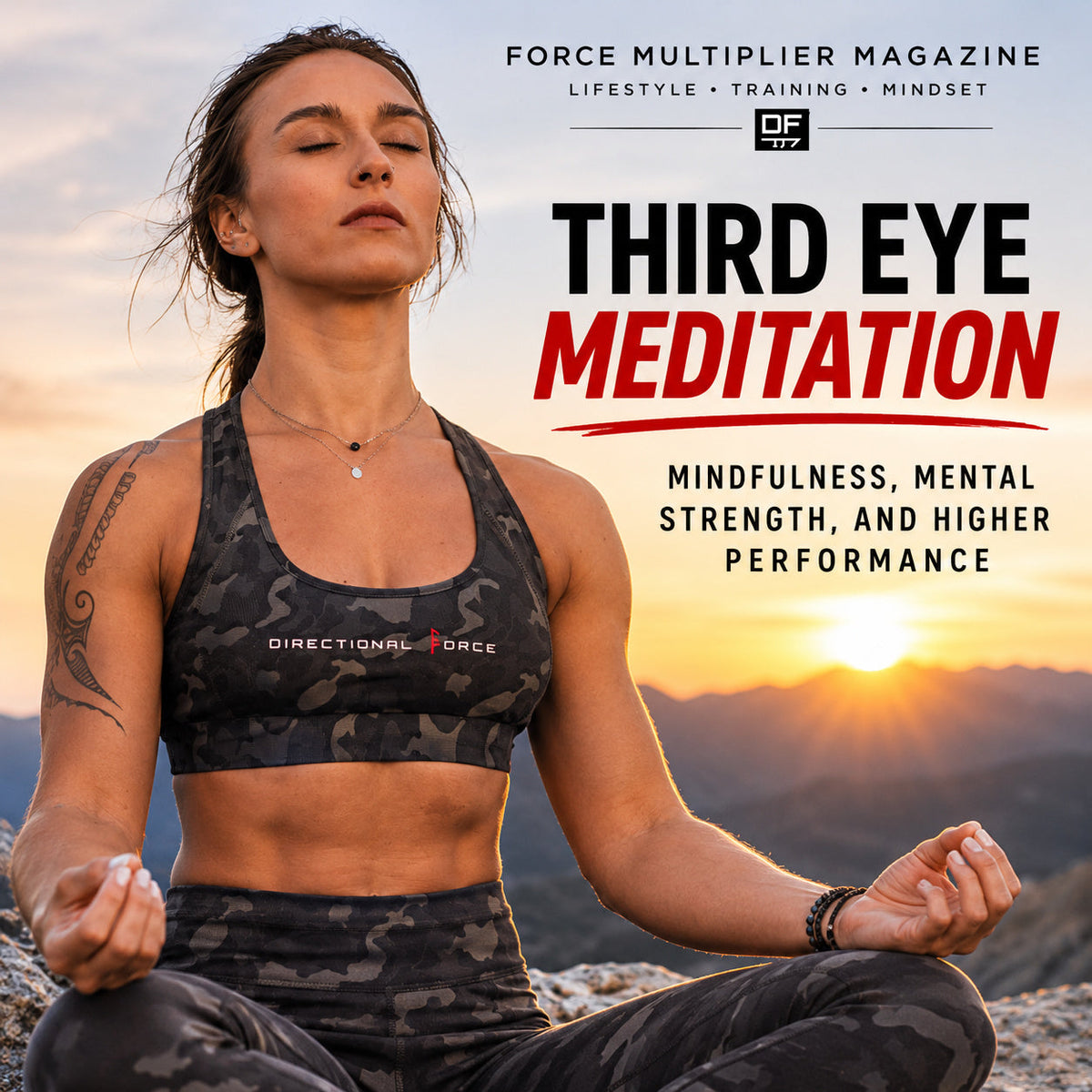
How mindfulness, meditation, and the discipline of turning inward can improve mental clarity, strengthen emotional resilience, and help you perform at a higher level.
We live in an age of unprecedented access to information.
Every morning, millions of people reach for their phones before their feet even touch the floor. Within minutes, they're exposed to political conflict, violence, economic uncertainty, tragedy, and the endless opinions of strangers.
Before the day has even begun, their attention has been pulled in a dozen directions.
And much of what they've consumed has little bearing on their ability to improve their own lives.
The modern world has become exceptionally good at capturing our attention. Unfortunately, it hasn't become equally good at protecting our peace of mind.
At Directional Force, we believe performance extends beyond physical strength.
A strong body is important. But so is a disciplined mind.
Whether you're an athlete, first responder, military professional, business owner, or someone simply trying to navigate life's challenges, your ability to manage your thoughts, emotions, and attention directly influences how you perform.
This is where mindfulness and meditation become powerful tools.
And one particularly interesting practice is known as third eye meditation.
What Is Third Eye Meditation?
Third eye meditation is a contemplative practice associated with ancient Hindu and yogic traditions.
The third eye, traditionally referred to as the Ajna chakra, is symbolically located between the eyebrows, slightly above the bridge of the nose.
In traditional spiritual teachings, it is associated with intuition, awareness, insight, and the ability to see beyond ordinary distractions.
However, understanding third eye meditation doesn't require adopting a particular religious or spiritual belief.
From a practical standpoint, the practice can be approached as a form of focused-attention meditation.
Rather than allowing the mind to wander endlessly between memories, worries, and external distractions, practitioners gently direct their attention toward a single point.
This may involve concentrating on the area between the eyebrows, observing the breath, or visualizing a point of light.
When thoughts arise, the objective isn't to fight them.
It's to recognize them and return attention to the chosen point of focus.
Over time, this process can help develop a valuable skill:
The ability to observe your thoughts without automatically reacting to them.
It's important to distinguish the traditional symbolism of the third eye from established neuroscience. Scientific research supports benefits of meditation and mindfulness, but it has not established that focusing on the third eye activates a special organ, unlocks supernatural perception, or produces unique neurological effects.
The practical value lies in the cultivation of attention and awareness.
The Mind Is a Muscle — Train It With Intention
In strength training, adaptation requires repeated exposure to an appropriate stimulus.
You challenge the muscles, allow them to recover, and gradually increase their capacity.
Mental training follows a different biological process, but the principle of consistent practice remains relevant.
Every time you sit quietly and redirect your wandering attention, you're practicing a form of mental discipline.
Consider what happens during a typical meditation session.
You begin by focusing on your breathing.
Within seconds, your mind wanders.
You remember an unfinished project.
You think about a difficult conversation.
You begin planning tomorrow's schedule.
Then you notice that your attention has drifted.
Instead of criticizing yourself, you calmly return to your breath.
That moment of recognition and redirection is central to the practice.
The objective isn't to eliminate thinking.
It's to develop a healthier relationship with your thoughts.
Just as physical training requires consistency, mindfulness becomes more useful through regular practice.
Five or ten minutes every day can be a reasonable starting point.
The Hidden Cost of Constantly Consuming Negative News
There is an important difference between being informed and being overwhelmed.
Staying aware of significant events can help us make responsible decisions, support our communities, and understand the world around us.
But repeatedly exposing ourselves to distressing headlines, graphic tragedies, political hostility, and social media outrage can create a cycle of unnecessary psychological stress.
This behavior is sometimes called doomscrolling.
It involves compulsively consuming negative information, often long after that information has stopped providing anything useful.
The problem isn't simply the content.
It's the repeated activation of worry, uncertainty, anger, or fear without a meaningful opportunity to respond.
Research has associated excessive exposure to distressing news with increased stress and psychological distress, although the relationship is complex and can work in both directions.
The more anxious someone feels, the more they may seek information.
And the more alarming information they consume, the more anxious they may become.
It's a cycle that can quietly consume an enormous amount of mental energy.
You Don't Have to Carry Every Tragedy
Compassion is important.
Awareness is important.
But being a compassionate person doesn't require immersing yourself in every tragedy occurring around the world.
You can care about people without allowing their suffering to dominate your emotional state throughout the day.
You can acknowledge a difficult event without consuming hours of commentary about it.
You can remain informed without surrendering your peace of mind.
Being informed is a choice. Being continuously emotionally consumed is not an obligation.
This is one of the most valuable lessons mindfulness can teach us.
We cannot control every event taking place in the world.
But we can become more intentional about what we allow into our minds.
And we can choose where to direct our energy.
Turn Inward Instead of Reacting Outward
Modern life constantly encourages external reactions.
Someone posts an opinion.
We feel compelled to respond.
A headline creates fear.
We search for more information.
A disagreement produces anger.
We replay the conversation repeatedly in our minds.
Before long, our emotional state is being influenced by people and events that have little direct connection to our daily responsibilities.
Meditation offers an alternative.
Instead of immediately reacting to an external stimulus, we practice creating space between the event and our response.
That space is where self-awareness develops.
Consider an athlete preparing for a major competition.
The athlete cannot control the crowd, the opponent, the weather, or every circumstance surrounding the event.
But they can work on controlling their preparation, breathing, attention, and response to pressure.
The same principle applies to everyday life.
You cannot control what someone says about you.
You cannot control every political decision.
You cannot prevent every tragedy.
But you can influence how much attention you give these events and how you respond.
Turning inward isn't about ignoring reality. It's about refusing to let every external event dictate your internal state.
The Science of Mindfulness and Mental Performance
Meditation has attracted considerable scientific interest over the past several decades.
Researchers have investigated its potential effects on stress, attention, emotional regulation, sleep, and psychological well-being.
Although the quality of research varies and meditation isn't a cure-all, several findings are particularly relevant to performance and mental health.
1. Reduced Stress and Anxiety
Mindfulness-based programs have demonstrated modest benefits for anxiety, depressive symptoms, and psychological stress in some populations.
A widely cited systematic review published in JAMA Internal Medicine found moderate evidence that mindfulness meditation programs can improve anxiety, depression, and pain outcomes.
Meditation may help individuals recognize stressful thoughts without immediately becoming absorbed in them.
Instead of automatically treating every worry as an emergency, practitioners learn to observe thoughts as mental events that may or may not require action.
2. Improved Attention and Concentration
Focused-attention meditation repeatedly trains the ability to notice distractions and return attention to a chosen object.
Some research suggests meditation can improve certain measures of attention and cognitive control.
Results vary depending on the type of practice, duration, and population studied.
For athletes, this skill has obvious practical applications.
A missed repetition doesn't have to ruin an entire workout.
A mistake during competition doesn't have to dictate the next performance.
The ability to redirect attention toward the task at hand can help reduce unnecessary mental interference.
3. Greater Emotional Regulation
Emotional regulation doesn't mean suppressing feelings.
It means recognizing emotions, understanding their influence, and responding in ways that align with your goals.
Mindfulness encourages awareness of emotional reactions before they become automatic behaviors.
This can be particularly useful during conflict, competition, and other high-pressure situations.
The goal isn't to become emotionless.
It's to become less controlled by every passing emotion.
4. Better Sleep and Recovery
Quality sleep is essential for physical recovery, cognitive performance, and emotional health.
Some studies suggest mindfulness-based interventions can improve subjective sleep quality, particularly among people experiencing sleep disturbances.
Meditation may help reduce repetitive thinking and mental arousal that can make it difficult to settle down at night.
However, it should complement rather than replace established sleep habits or treatment for persistent sleep disorders.
5. Improved Athletic Performance Under Pressure
Mindfulness-based approaches have been studied in athletes for their potential effects on concentration, anxiety, and performance.
Some findings are promising, particularly for psychological skills such as present-moment attention and acceptance.
However, direct improvements in athletic performance are less consistently established.
Meditation should therefore be viewed as a potential complement to physical training, technical preparation, and recovery—not a substitute for them.
How to Practice Third Eye Meditation: A Simple 10-Minute Routine
You don't need specialized equipment, an elaborate setting, or years of experience to begin.
A quiet space and a willingness to practice are enough.
Step 1: Find a Quiet Environment (1 Minute)
Sit comfortably in a chair or on the floor.
Keep your spine naturally upright, shoulders relaxed, and hands resting comfortably.
Close your eyes if that feels comfortable, or maintain a soft downward gaze.
Allow yourself to settle into the present moment.
Step 2: Establish Your Breathing (2 Minutes)
Begin breathing naturally through your nose if comfortable.
Notice the sensation of air entering and leaving your body.
You may gently lengthen your exhalation if it feels relaxing, but avoid forcing or holding your breath.
As your breathing settles, allow unnecessary muscular tension to soften.
Step 3: Direct Attention Toward the Third Eye (3 Minutes)
With your eyes relaxed, bring your awareness toward the area between your eyebrows.
There is no need to cross your eyes, strain your facial muscles, or physically force your gaze upward.
Simply imagine a gentle point of awareness in that region.
Some practitioners visualize a small light.
Others focus on the sensation of stillness.
Neither approach is required.
If focusing on this area creates discomfort, return to observing your breathing instead.
The purpose is concentration, not physical strain.
Step 4: Observe Your Thoughts (3 Minutes)
As thoughts arise, notice them without judgment.
You might find yourself thinking about work, relationships, responsibilities, or something you saw in the news.
Instead of following the thought, acknowledge it.
Then return your attention to your chosen point of focus.
You don't have to solve every problem that appears in your mind.
You don't have to respond to every memory.
And you don't have to believe every thought.
Practice allowing thoughts to come and go.
Step 5: Return to the Present (1 Minute)
Gradually shift your attention back toward your breathing and the physical sensations of sitting.
Notice how your body feels.
Open your eyes gently.
Before reaching for your phone or returning to your responsibilities, take a moment to establish an intention for the day.
Perhaps it's patience.
Perhaps it's focus.
Perhaps it's simply refusing to spend unnecessary energy on things outside your control.
Ten minutes of intentional awareness can be a useful way to begin the day.
Consistency matters more than the length of any individual session.
A Morning Routine for Higher Performance
One of the simplest ways to incorporate mindfulness into daily life is to combine it with other healthy morning habits.
Instead of immediately opening news applications or social media, consider starting the day with a deliberate routine.
| Activity | Duration | Purpose |
|---|---|---|
| Natural morning light | 5–10 minutes | Support circadian rhythm and wakefulness |
| Third eye meditation | 10 minutes | Practice attention and self-awareness |
| Light mobility or stretching | 5 minutes | Prepare the body for movement |
| Set daily priorities | 2–3 minutes | Direct attention toward meaningful goals |
Morning light exposure can support circadian timing, while gentle movement can help transition into the day's activities.
Meditation provides an opportunity to establish a more deliberate mental state before encountering external demands.
The goal isn't to create a perfect morning.
It's to avoid allowing your phone, the news cycle, or someone else's agenda to determine the direction of your attention before you've decided what matters.
The Discipline of Selective Attention
One of the greatest challenges of modern life isn't a lack of information.
It's an excess of it.
Every notification, advertisement, headline, and social media post competes for a limited resource:
Your attention.
And attention influences behavior.
What you repeatedly focus on can shape your emotional experience, priorities, and daily decisions.
If you spend your mornings consuming conflict, you may begin your day feeling agitated.
If you spend your evenings scrolling through distressing news, you may find it harder to disengage before sleep.
But if you intentionally direct your attention toward training, learning, meaningful relationships, and personal growth, you create more opportunities to act in accordance with those priorities.
This doesn't mean ignoring difficult realities.
It means recognizing that not every event deserves unlimited access to your mind.
Five Ways to Protect Your Mental Energy
1. Establish boundaries with the news. Choose one or two brief periods to catch up on important developments rather than checking headlines continuously.
2. Avoid beginning the day with social media. Give yourself time to establish your own priorities before absorbing everyone else's opinions.
3. Practice daily stillness. Even five minutes of quiet breathing can provide an opportunity to recognize habitual thought patterns.
4. Focus on actionable concerns. When a situation is troubling, ask whether there's a meaningful step you can take. If not, consider whether continued consumption is helping.
5. Replace passive consumption with purposeful action. Exercise, read, spend time outdoors, connect with loved ones, or work toward a personal goal.
Protecting your attention isn't selfish.
It's a form of personal responsibility.
Mental Strength Doesn't Mean Never Struggling
There is an important distinction between resilience and emotional suppression.
Mental strength doesn't mean pretending that difficult experiences don't affect us.
It doesn't mean avoiding grief, denying anxiety, or refusing to seek help.
And it certainly doesn't mean that people experiencing depression or other mental health conditions simply need more discipline.
Mindfulness can be a useful component of mental well-being, but it isn't a replacement for professional mental health care when that care is needed.
Some individuals may also experience increased distress during meditation, particularly when dealing with trauma or intense emotional difficulties.
For those individuals, shorter practices, eyes-open grounding exercises, or guidance from a qualified professional may be more appropriate.
True resilience includes recognizing when additional support is necessary.
The purpose of meditation isn't to escape being human.
It's to become more aware of the human experience and respond to it with greater intention.
The Directional Force Perspective: Strength Begins Within
At Directional Force, our philosophy has always extended beyond simply lifting weights or pushing through difficult workouts.
Run. Ruck. Lift. Live.
Those four words represent movement, discipline, resilience, and the pursuit of a stronger life.
But physical performance is only one part of that equation.
The mind influences our willingness to train, our ability to remain consistent, and how we respond when circumstances become difficult.
You can develop extraordinary physical strength and still struggle with an undisciplined relationship with stress, distraction, or negative thinking.
Likewise, you can spend hours consuming information about events outside your control while neglecting the things directly within your influence.
Your health.
Your relationships.
Your physical fitness.
Your personal development.
Your daily decisions.
Meditation encourages us to redirect attention toward the present moment and the choices available to us.
It reminds us that not every thought requires a reaction.
Not every headline requires our emotional investment.
And not every external event deserves the power to determine how we experience our day.
There's a time to engage with the world.
There's a time to help others.
And there's also a time to turn inward, regain perspective, and protect the mental energy necessary to live purposefully.
Train your body to meet the demands of life. Train your mind to determine how you respond to them.
Final Thoughts: Find Strength in Stillness
We often associate strength with action.
Lifting heavier weights.
Running farther.
Working harder.
Pushing through adversity.
But there's another form of strength that deserves equal consideration.
The ability to sit quietly.
To observe your thoughts without becoming consumed by them.
To experience uncertainty without immediately searching for another distraction.
To recognize that peace of mind doesn't require controlling everything happening around you.
Third eye meditation offers one traditional approach to developing this kind of inward awareness.
Modern mindfulness practices offer related tools supported by a growing, though still evolving, body of scientific research.
Neither requires you to withdraw from the world.
Instead, they invite you to participate in life with greater awareness and intention.
The world will continue producing headlines.
There will always be another controversy, another crisis, and another reason to feel distracted.
But your attention remains one of the most valuable resources you possess.
Be informed. Be compassionate. Be engaged. But don't surrender your peace of mind to things you cannot control.
Sometimes the most productive thing you can do isn't to push harder.
It's to become still.
Live-Life
Research and Further Reading
-
Goyal, M., et al. (2014). "Meditation Programs for Psychological Stress and Well-being: A Systematic Review and Meta-analysis." JAMA Internal Medicine, 174(3), 357–368. Read the study
-
Tang, Y.-Y., Hölzel, B. K., & Posner, M. I. (2015). "The Neuroscience of Mindfulness Meditation." Nature Reviews Neuroscience, 16, 213–225. Read the study
-
Black, D. S., et al. (2015). "Mindfulness Meditation and Improvement in Sleep Quality and Daytime Impairment Among Older Adults With Sleep Disturbances." JAMA Internal Medicine, 175(4), 494–501. Read the study
-
Holman, E. A., Garfin, D. R., & Silver, R. C. (2014). "Media's Role in Broadcasting Acute Stress Following the Boston Marathon Bombings." Proceedings of the National Academy of Sciences, 111(1), 93–98. Read the study
-
National Center for Complementary and Integrative Health (NCCIH). "Meditation and Mindfulness: Effectiveness and Safety." NIH overview
Disclaimer: This is for informational purposes only and is not medical advice. Consult a healthcare provider before making significant changes to sodium or fluid intake, especially if you have high blood pressure, kidney disease, or other medical conditions. Individual needs vary widely based on sweat rate, climate, training load, and health status.
Consult your physician before starting any peptide or supplement and making any dietary changes, etc. Consult a fitness professional before starting any new workout, especially if you have pre-existing injuries. Listen to your body and adjust weights or reps as needed. Always consult a healthcare provider before starting any workout program, physical activity, or taking any supplement to make sure that you're healthy enough.
The content contained in this article is for information purposes only, and is not meant to be a substitute or replacement for professional advice and medical consultation. It is just shared as information only, and with the understanding that Directional Force, LLC, (Directional Force) is not engaged in the provision or rendering of medical advice or services whatsoever. You unilaterally understand and agree that Directional Force shall not be liable for any claim, loss, or damage arising out of the use of, or reliance upon any content or information in this article or any article provided by Directional Force. Please seek professional medical advice prior to engaging in, or undertaking any of the content, exercises, advice, and workouts provided by Directional Force.