
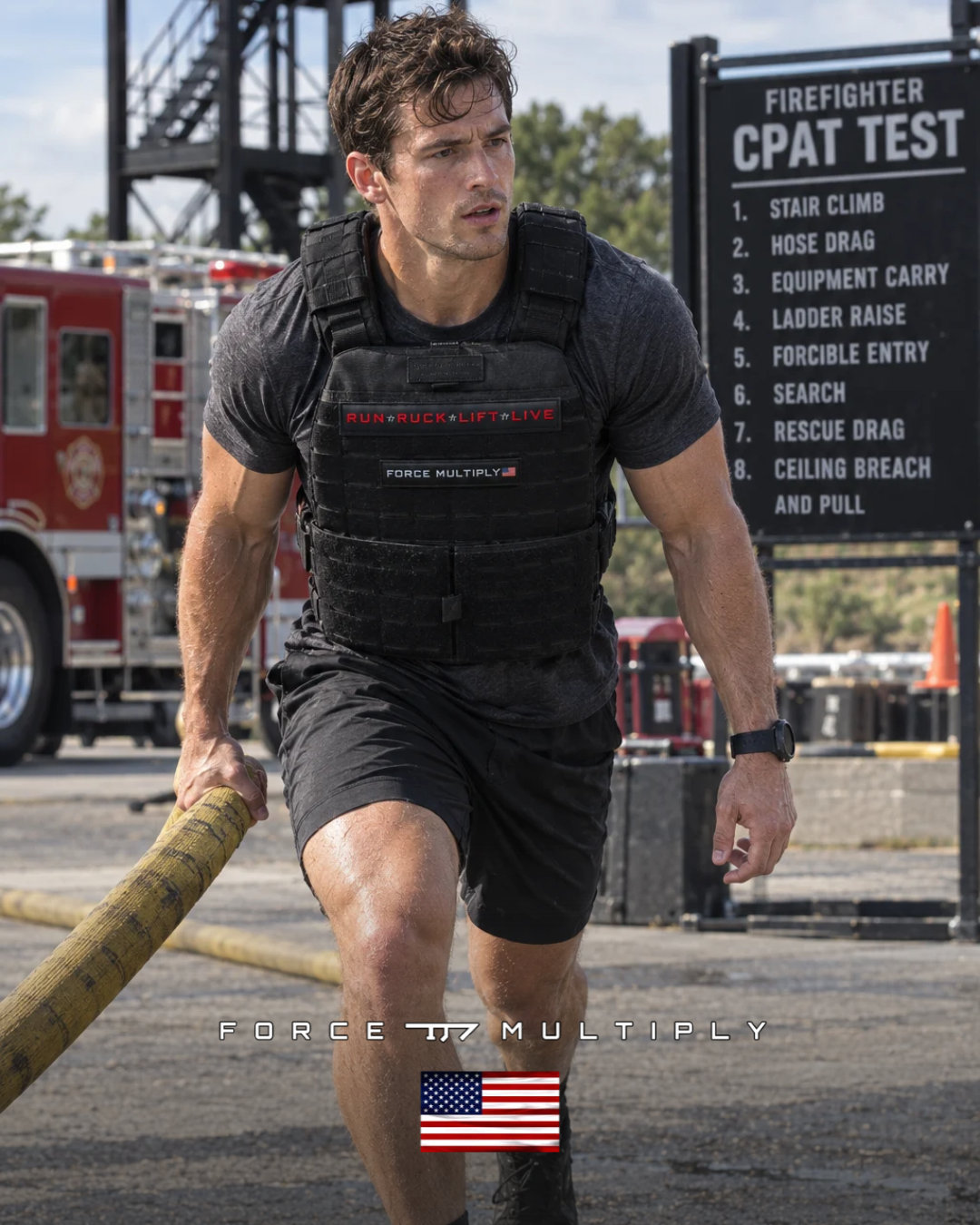
The Candidate Physical Ability Test (CPAT) is the standardized physical gateway used by hundreds of fire departments across the United States and Canada. Developed through the IAFF/IAFC Fire Service Joint Labor Management Wellness/Fitness Initiative, it is a continuous, pass/fail sequence of eight job-related events. Candidates must complete the entire course in 10 minutes and 20 seconds or less while wearing a 50-pound vest that simulates turnout gear and SCBA. An additional 25 pounds (two 12.5-pound shoulder weights simulating a high-rise pack) is added only for the first event. Between stations there is an approximately 85-foot walk that provides roughly 20 seconds of recovery; running between events is not allowed and can result in a warning or failure.
Success requires more than general fitness. It demands aerobic capacity under load, leg endurance, grip strength that lasts when fatigue accumulates, posterior-chain power for drags, and the ability to maintain technique when the clock is running. The stair climb sets the tone; many candidates who “pass” it still fail later because they redlined too early. Consistent, progressive training under a well-fitted weight vest is one of the highest-leverage tools for building the specific work capacity the test demands.
The Directional Force Centurion Weight Vest is particularly well-suited for this preparation. Its secure, low-shift fit (padded straps, adjustable Velcro waist system, and interior nodule system), durable construction, and plate-pocket capacity (supporting progressive loads up to roughly 60 pounds total) allow candidates to train the exact loaded movements that appear on test day without the distraction of a vest that rides up or bounces.
The Eight CPAT Events
1. Stair Climb
Using a StepMill, candidates complete a 20-second warm-up at 50 steps per minute, then three minutes at 60 steps per minute with the full 75-pound load (50 lb vest + 25 lb shoulder pack). This simulates climbing stairs in full gear while carrying a high-rise pack. Primary demands are aerobic capacity and lower-body muscular endurance. Failure points include falling or stepping off after the timed portion begins, or a third rail-grasp infraction.
2. Hose Drag
Candidates grasp the nozzle of an uncharged 1¾-inch hose (200 feet total), drape it over the shoulder or chest (not past the 8-foot mark), drag it 75 feet to a drum, make a 90-degree turn, continue 25 feet, then drop to at least one knee inside a marked box and pull the hose hand-over-hand until the 50-foot mark crosses the finish line. Running is permitted during the drag. Key challenges are lower-body power, grip endurance, and upper-back strength under accumulating fatigue.
3. Equipment Carry
Two power saws (roughly 28–32 pounds each) are removed one at a time from a cabinet, carried one in each hand 75 feet around a drum and back (150 feet total), then returned to the cabinet. Walking is required; a second running warning fails the candidate. Grip, shoulder endurance, and balance under load are tested.
4. Ladder Raise and Extension
Candidates raise a 24-foot aluminum extension ladder hand-over-hand from the ground to a vertical position against a wall, then move to a second ladder, stand inside a marked box, and extend the fly section via the halyard hand-over-hand until it hits the stop before lowering it under control. Loss of control of the ladder or uncontrolled rope slip results in failure. Technique and controlled upper-body strength matter as much as raw power.
5. Forcible Entry
Using a 10-pound sledgehammer, candidates strike a measuring device in a target area until a buzzer sounds. Feet must remain outside a toe-box. This simulates forcing a door or breaching a wall and taxes grip, core stability, and anaerobic power under fatigue.
6. Search
Candidates crawl through a dark, enclosed tunnel maze approximately 3 feet high, 4 feet wide, and 64 feet long that includes 90-degree turns, obstacles, and two narrowed sections. The event tests aerobic capacity, agility, kinesthetic awareness, and the ability to stay composed in a confined space. Calling for assistance that requires opening hatches results in failure.
7. Rescue
Candidates grasp the shoulder harness handles of a 165-pound mannequin, drag it 35 feet, make a 180-degree turn around a drum, and continue another 35 feet so the entire mannequin crosses the finish line. Grasping or resting on the drum is not permitted (warning; second is failure). This is one of the most anaerobic events and arrives when candidates are already taxed.
8. Ceiling Breach and Pull
Using a pike pole, candidates push a 60-pound hinged ceiling panel fully upward three times, then hook and pull an 80-pound device downward five times. This set (3 pushes + 5 pulls) is repeated four times while remaining inside the equipment frame. Grip adjustments are allowed. Dropping the pike pole or stepping outside the boundary draws a warning; a second ends the test. The clock stops on the final successful pull. This event challenges upper-body endurance and grip when the candidate is most fatigued.

10–12 Week CPAT Training Program
This progressive program emphasizes specificity, progressive overload under load, and recovery. It assumes a baseline ability to walk/jog and perform basic strength movements. Consult a physician before beginning. Train 4–5 days per week. Use the Centurion Vest for all loaded sessions; start with a manageable load (for many, 20–30 pounds total) and add 5–10 pounds every 1–2 weeks as technique and recovery allow, working toward sustained work at 40–50+ pounds. The vest’s secure fit and plate pockets make it practical for stairs, carries, rucking, and circuits.
Phase 1: Base Building (Weeks 1–4)
Focus: Aerobic base, movement quality, grip introduction, and adapting to the vest.
- 2–3× per week: StairMill or real stairs, 10–15 minutes continuous or intervals (start unweighted or light vest).
- 2× strength: Goblet or back squats, Romanian deadlifts, step-ups, rows, overhead presses, farmer carries (dumbbells or kettlebells).
- 1× loaded walk/ruck in the Centurion Vest (20–30 min).
- Grip: Dead hangs, farmer carries, and towel or rope pulls.
- Optional: Easy Zone-2 cardio on non-strength days.
Phase 2: Specific Strength and Load (Weeks 5–8)
Focus: Event-pattern training and progressive vest loading.
- Stair sessions 2×/week: Work toward 3–4 minutes at or near 60 steps/minute with 40–50+ pounds in the Centurion. Add a shoulder pack or light plate if simulating the full 75-pound start.
- Circuit 1–2×/week (wear vest for portions): Farmer carries (aim for 30–50+ lb per hand over 75–150 ft), sled or weighted-bag drags, rope or towel hand-over-hand pulls, sledgehammer swings against a tire or pad, crawling drills, and overhead presses or pike-pole simulations (rope or band pulls).
- Strength: Emphasize posterior chain (deadlifts, hip hinges, lunges), upper-body pulling, and carries.
- One longer loaded ruck or walk per week.
Phase 3: Simulation and Peak (Weeks 9–11 or 12)
Focus: Full-sequence work capacity, pacing, and transitions.
- 1–2 partial or full practice circuits per week that string together stair work, carries, drags, and overhead work with only short walks between.
- Continue stair-specific work and grip finishers.
- Taper volume in the final 7–10 days while keeping intensity moderate; prioritize sleep, nutrition, and mobility.
- Attend official orientations and timed practice sessions offered by the testing agency—these are invaluable for learning exact equipment and failure points.
Weekly Template Example (Phase 2)
- Day 1: Weighted stairs (Centurion) + lower-body strength + farmer carries.
- Day 2: Steady aerobic or easy ruck.
- Day 3: Rest or mobility.
- Day 4: Event circuit (drags, pulls, sledge, crawl) in or with vest segments.
- Day 5: Upper-body strength + grip + light loaded walk.
- Days 6–7: Rest or active recovery.
Additional Keys to Success
- Pace the stair climb. Going out too hard leaves nothing for the rescue and ceiling events.
- Practice transitions. The 85-foot walks are recovery opportunities—use them, but do not stop moving.
- Build grip specifically. Farmer carries, rope pulls, and dead hangs done after other work prepare the forearms for late-test demands.
- Train under load regularly. The Centurion’s secure, adjustable design lets you accumulate high-quality volume on stairs, rucks, and carries without the vest becoming a distraction.
- Recovery matters. Sleep, protein intake, and easy movement on off days support adaptation.
- Technique first. Attend orientations; practicing the exact ladder raise, hose pull, and ceiling sequence reduces wasted energy on test day.
You can’t fail if you don’t quit. The CPAT rewards consistent preparation more than last-minute heroics. Progressive loading with a reliable tool like the Centurion Weight Vest builds the exact work capacity—legs, grip, aerobic base under load, and mental composure—that lets candidates finish the sequence inside 10:20 with energy to spare. Combine the program above with official practice sessions, and you will arrive on test day ready to execute rather than survive.
For candidates seeking the secure, progressive loading that translates directly to CPAT success, the Centurion Weight Vest from Directional Force provides a durable, purpose-built platform. Pair it with disciplined training and the result is more than a passing time—it is the foundation of a long, high-performance career.
Disclaimer: This is for informational purposes only and is not medical advice. Consult a healthcare provider before making significant changes to sodium or fluid intake, especially if you have high blood pressure, kidney disease, or other medical conditions. Individual needs vary widely based on sweat rate, climate, training load, and health status.
Consult your physician before starting any peptide or supplement and making any dietary changes, etc. Consult a fitness professional before starting any new workout, especially if you have pre-existing injuries. Listen to your body and adjust weights or reps as needed. Always consult a healthcare provider before starting any workout program, physical activity, or taking any supplement to make sure that you're healthy enough.
The content contained in this article is for information purposes only, and is not meant to be a substitute or replacement for professional advice and medical consultation. It is just shared as information only, and with the understanding that Directional Force, LLC, (Directional Force) is not engaged in the provision or rendering of medical advice or services whatsoever. You unilaterally understand and agree that Directional Force shall not be liable for any claim, loss, or damage arising out of the use of, or reliance upon any content or information in this article or any article provided by Directional Force. Please seek professional medical advice prior to engaging in, or undertaking any of the content, exercises, advice, and workouts provided by Directional Force.