
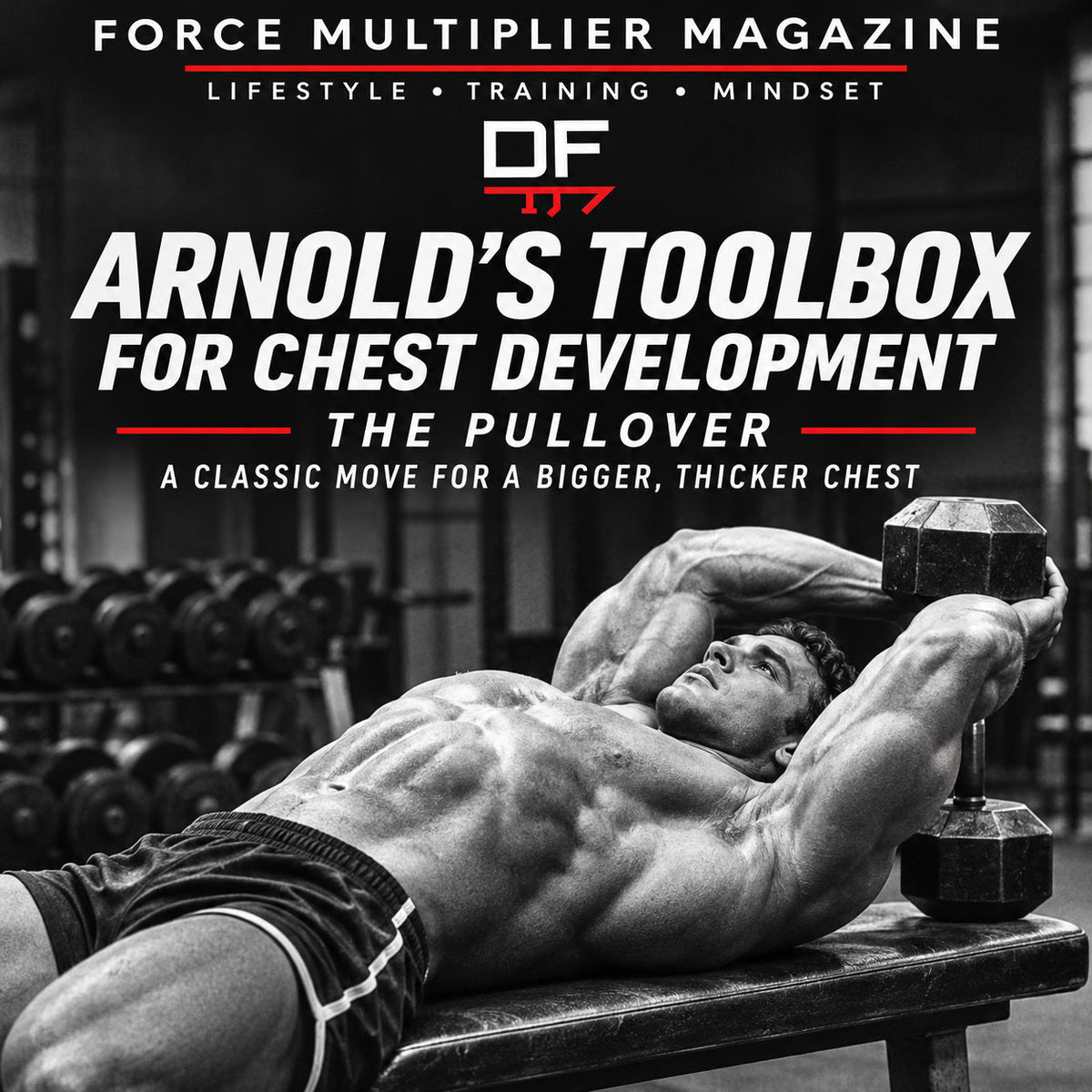
In the golden era of bodybuilding, building an impressive physique was about more than simply moving heavy weight. It was about developing muscular thickness, symmetry, proportion, and understanding how to make every repetition count.
Few athletes embodied this philosophy better than Arnold Schwarzenegger.
While Arnold was renowned for his heavy bench presses, incline presses, and dumbbell flyes, one exercise he frequently incorporated into his training has largely disappeared from modern chest routines: the dumbbell pullover.
Once a staple among legendary bodybuilders, the pullover offers a unique combination of muscular tension, loaded stretching, and upper-body development that conventional pressing movements cannot fully replicate.
Perhaps it's time to bring it back.
Why Arnold Believed in the Pullover


Arnold believed that dumbbell pullovers contributed to the development of a thick, expansive chest and the dramatic upper-body proportions that defined golden-era bodybuilding.
Bodybuilders of that generation also believed pullovers could expand the rib cage, particularly when combined with deep breathing.
Although there is little scientific evidence that pullovers permanently expand the skeletal rib cage in mature adults, the exercise can contribute to muscular development around the chest and torso, creating the appearance of a fuller, more powerful upper body.
Arnold's training philosophy emphasized stretching the muscle under resistance, maintaining muscular tension, and developing a strong mind-muscle connection.
The pullover incorporates all three.
What Muscles Does the Dumbbell Pullover Work?
Unlike many traditional chest exercises, the pullover recruits multiple muscle groups through shoulder extension.
The primary and supporting muscles include:
-
Pectoralis major: Contributes to chest development and bringing the upper arms forward from the overhead position.
-
Latissimus dorsi: Assists in shoulder extension and contributes to upper-body width and thickness.
-
Serratus anterior: Helps stabilize and control the shoulder blades.
-
Triceps: Particularly the long head, which assists with shoulder extension and elbow stabilization.
-
Core musculature: Helps maintain torso stability throughout the movement.
Interestingly, a 2011 electromyography study published in the Journal of Applied Biomechanics found that the barbell pullover elicited greater activation of the pectoralis major than the latissimus dorsi under the conditions tested.
While muscle activation alone does not establish superior muscle growth, the findings support the pullover's inclusion in a chest-focused training program.
How to Perform the Classic Arnold Dumbbell Pullover
The traditional golden-era variation is performed with the upper back positioned perpendicular to a flat bench rather than lying lengthwise along it.
Step 1: Establish Your Position
-
Position your upper back and shoulder blades across a sturdy flat bench.
-
Plant your feet firmly on the floor.
-
Keep your hips slightly below the level of the bench without excessively arching your lower back.
-
Hold a single dumbbell securely with both hands.
Step 2: Establish the Starting Position
-
Position the dumbbell directly above your chest.
-
Maintain a slight bend in your elbows.
-
Engage your abdominal muscles and maintain a stable torso.
-
Keep your grip secure and your wrists in a comfortable position.
Step 3: Lower the Weight
-
Slowly lower the dumbbell backward in a controlled arc behind your head.
-
Maintain a relatively consistent elbow angle throughout the movement.
-
Inhale as you lower the weight.
-
Continue until you feel a comfortable stretch through your chest and upper torso.
Do not force the dumbbell beyond your natural shoulder mobility.
Step 4: Contract and Return
-
Focus on bringing your upper arms forward using your chest and supporting musculature.
-
Return the dumbbell to the starting position in a controlled arc.
-
Exhale as you complete the repetition.
-
Avoid using momentum or turning the movement into a triceps extension.
The objective is muscular tension, not simply moving the dumbbell from point A to point B.
Five Benefits of the Dumbbell Pullover
1. Loaded Stretching of the Chest
Traditional bench presses and flyes primarily challenge the chest through horizontal shoulder movement.
The pullover challenges the pectoral muscles through a different movement pattern, placing them under resistance as the arms move overhead.
Emerging research on resistance training at longer muscle lengths suggests that loaded stretching may contribute to hypertrophy, although direct research on pullover-specific muscle growth remains limited.
2. Greater Upper-Body Thickness
By recruiting the chest, lats, and surrounding musculature, pullovers can complement a comprehensive upper-body development program.
This combination can contribute to the thick, powerful appearance associated with classic bodybuilding physiques.
3. Serratus Anterior Development
The serratus anterior is often overlooked in conventional bodybuilding programs.
Located along the sides of the rib cage, this muscle contributes to shoulder blade control, stability, and the muscular detail visible along a well-developed torso.
Pullovers involve the serratus, although exercises such as push-up plus variations can target it more directly.
4. Improved Active Shoulder Mobility
When performed through a controlled, pain-free range of motion, pullovers can help develop strength and control in overhead positions.
This may complement other forms of mobility training, particularly for athletes whose routines consist primarily of pressing and pulling movements.
5. A Stronger Mind-Muscle Connection
The slow, deliberate nature of the pullover encourages athletes to focus on muscular contraction rather than maximum weight.
Arnold was a strong advocate of mentally connecting with the muscle being trained.
The pullover is an excellent opportunity to practice that philosophy.
Arnold-Inspired Chest Workout
The following workout is inspired by golden-era bodybuilding principles rather than a reproduction of Arnold's exact training routine.
|
Exercise |
Sets |
Repetitions |
|---|---|---|
|
Barbell Bench Press |
4 |
6–10 |
|
Incline Dumbbell Press |
3 |
8–12 |
|
Flat Dumbbell Flyes |
3 |
10–12 |
|
Dumbbell Pullovers |
3 |
10–15 |
Recommended pullover technique
|
Training variable |
Recommendation |
|---|---|
|
Lowering phase |
3 seconds |
|
Stretched position |
1-second controlled pause |
|
Lifting phase |
1–2 seconds |
|
Rest between sets |
60–90 seconds |
|
Frequency |
1–2 times per week |
|
Intensity |
Finish with 1–3 repetitions in reserve |
Perform pullovers toward the end of your chest workout, when the primary pressing movements have already been completed.
Start with a moderate weight and gradually increase resistance as your technique, strength, and shoulder mobility improve.
Common Mistakes to Avoid
The pullover is a relatively simple exercise, but poor execution can place unnecessary stress on the shoulders and lower back.
Avoid using excessive weight, bending and straightening the elbows throughout the repetition, aggressively dropping the hips, excessively arching the lower back, or forcing the shoulders into an uncomfortable stretched position.
If the traditional cross-bench variation feels uncomfortable, perform the exercise while lying lengthwise on a flat bench. This provides additional support for the head, back, and hips.
Remember, the deepest possible stretch is not necessarily the most productive stretch.
Why Did the Pullover Disappear?
Modern gyms are filled with sophisticated chest machines, cable stations, and specialized resistance equipment.
While these tools have their advantages, many classic free-weight movements have gradually fallen out of favor.
The pullover also occupies an unusual position in exercise programming. Some athletes consider it a chest exercise, while others classify it as a back exercise.
Perhaps that versatility is precisely what makes it valuable.
Not every exercise needs to isolate a single muscle group to be effective.
Sometimes the movements that challenge multiple muscles through a unique range of motion deserve a permanent place in our training programs.
The Directional Force Perspective: Old School. Timeless Principles.
At Directional Force, we believe that effective training does not always require the latest equipment, complicated programming, or whatever fitness trend happens to be dominating social media.
The fundamentals of strength and muscular development remain remarkably consistent.
Progressive overload. Controlled repetitions. Proper nutrition. Adequate recovery. Discipline.
The legendary physiques of the golden era were built without many of the technological advantages available to athletes today. What those athletes possessed was an understanding of their bodies, a willingness to experiment, and an unwavering commitment to their training.
The dumbbell pullover is a reminder that an exercise doesn't become obsolete simply because it is no longer popular.
Sometimes moving forward means rediscovering what worked in the past.
Train with purpose. Train with discipline. Never stop learning.
DIRECTIONAL FORCE | RUN · RUCK · LIFT · LIVE
You can't fail – if you don't quit.
-
Research and recommended reading
-
Marchetti, P. H., & Uchida, M. C. (2011). Effects of the Pullover Exercise on the Pectoralis Major and Latissimus Dorsi Muscles as Evaluated by EMG. Journal of Applied Biomechanics, 27(4), 380–384.
-
Schwarzenegger, A., & Dobbins, B. The New Encyclopedia of Modern Bodybuilding.
-
Schoenfeld, B. J. Science and Development of Muscle Hypertrophy.
Disclaimer: This is for informational purposes only and is not medical advice. Consult a healthcare provider before making significant changes to sodium or fluid intake, especially if you have high blood pressure, kidney disease, or other medical conditions. Individual needs vary widely based on sweat rate, climate, training load, and health status.
Consult your physician before starting any peptide or supplement and making any dietary changes, etc. Consult a fitness professional before starting any new workout, especially if you have pre-existing injuries. Listen to your body and adjust weights or reps as needed. Always consult a healthcare provider before starting any workout program, physical activity, or taking any supplement to make sure that you're healthy enough.
The content contained in this article is for information purposes only, and is not meant to be a substitute or replacement for professional advice and medical consultation. It is just shared as information only, and with the understanding that Directional Force, LLC, (Directional Force) is not engaged in the provision or rendering of medical advice or services whatsoever. You unilaterally understand and agree that Directional Force shall not be liable for any claim, loss, or damage arising out of the use of, or reliance upon any content or information in this article or any article provided by Directional Force. Please seek professional medical advice prior to engaging in, or undertaking any of the content, exercises, advice, and workouts provided by Directional Force.
AI-generated editorial illustration inspired by golden-era bodybuilding. Not an authentic photograph of Arnold Schwarzenegger
-