
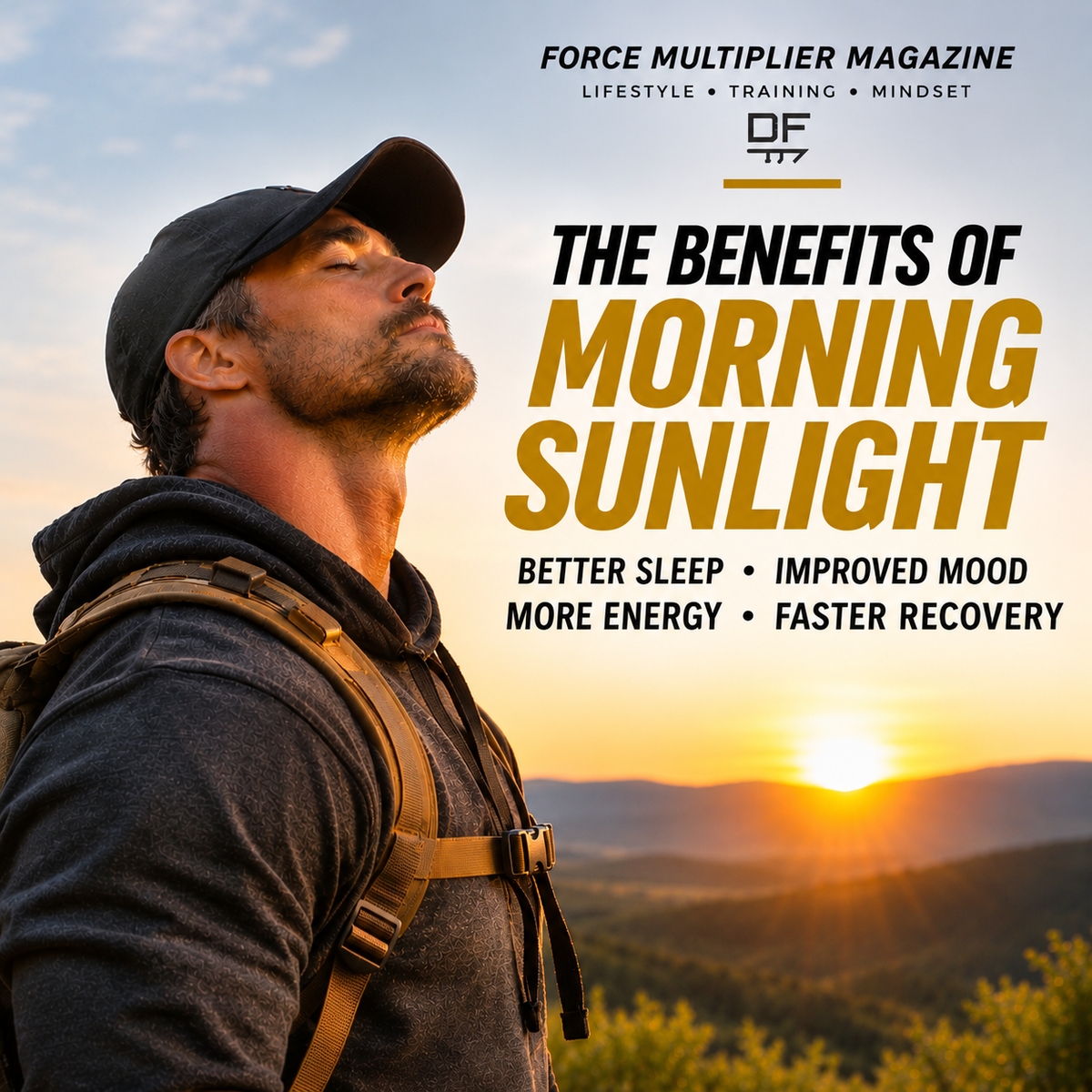
How morning sunlight supports your circadian rhythm, mental health, energy, and overall well-being.
FORCE MULTIPLIER MAGAZINE | DIRECTIONAL FORCE
What if one of the most powerful tools for improving your health wasn't found in a supplement bottle, a gym, or a doctor's office—but right outside your front door?
Every morning, sunlight delivers something our bodies have evolved to depend on: a powerful biological signal that helps regulate sleep, alertness, mood, and countless processes essential to human health.
Modern life has dramatically changed our relationship with natural light. We spend much of our time indoors, staring at screens under artificial lighting, often missing the sunlight that helps synchronize our internal biological clocks.
Yet research continues to demonstrate that exposure to natural daylight, particularly in the morning, plays an important role in physical and mental well-being.
At Directional Force, we believe performance is about more than how hard you train. It's about how well you recover, how consistently you sleep, and how you support the biological systems that keep your body functioning.
And one of the simplest ways to support those systems is to step outside.
1. Morning Sunlight Resets Your Circadian Rhythm
Your body operates on an approximately 24-hour internal clock known as the circadian rhythm.
This biological timing system helps regulate:
-
Sleep and wake cycles
-
Hormone release
-
Body temperature
-
Alertness and cognitive performance
-
Metabolism and energy regulation
-
Daily patterns of physical performance
At the center of this system is a small region of the brain called the suprachiasmatic nucleus (SCN), located in the hypothalamus.
Specialized light-sensitive cells in your eyes detect environmental light and send signals to this internal clock.
Morning light is especially important because it helps tell your brain that the biological day has begun.
For many people, appropriately timed morning light helps shift their circadian clock earlier, supporting earlier sleep and wake times. The precise effect depends on individual circadian timing.
Why This Matters for Sleep
Morning light helps synchronize the timing of melatonin, the hormone that signals biological nighttime.
Melatonin normally rises in the evening and falls toward morning. Bright light at the appropriate time helps suppress remaining daytime melatonin and promote wakefulness.
By reinforcing a consistent day-night rhythm, morning light can help support more predictable sleep timing.
The takeaway: Better sleep begins long before your head hits the pillow. Your morning light environment helps determine when your body prepares for sleep later that evening.
Research: Khalsa et al., 2003 — A phase response curve to single bright light pulses in human subjects
2. Sunlight and Its Antidepressant Effects
One of the most compelling areas of light research involves its relationship with mental health.
Light exposure influences brain systems involved in circadian timing, alertness, and mood regulation.
Research has established that appropriately administered bright-light therapy can be effective for certain depressive disorders, particularly seasonal affective disorder (SAD).
SAD is a form of depression that follows a seasonal pattern, often emerging during fall and winter when daylight hours become shorter.
Symptoms may include persistent low mood, fatigue, changes in sleep, and reduced motivation.
The Connection Between Sunlight and Serotonin
Serotonin is a neurotransmitter involved in mood regulation and numerous other biological functions.
Research has identified associations between seasonal sunlight exposure and markers of serotonin activity.
A frequently cited study published in The Lancet found that the rate of serotonin production measured in the brain was associated with the duration of bright sunlight exposure.
Although this finding is intriguing, it does not prove that spending a particular number of minutes in the sun will directly increase serotonin or treat depression.
Nevertheless, light's influence on circadian and mood-regulating systems helps explain why light-based interventions have become an important area of mental health research.
Can Morning Sunlight Improve Your Mood?
For many people, getting outside in the morning may support mood through a combination of daylight exposure, physical activity, and improved sleep timing.
However, natural sunlight is not a guaranteed antidepressant treatment, and outdoor exposure should not be considered a replacement for professional care when depression is present.
The takeaway: Morning daylight is a valuable daily habit for supporting mental well-being, while clinically prescribed bright-light therapy has stronger direct evidence for treating certain forms of depression.
Research:
-
Lam et al., 2016 — Efficacy of Bright Light Treatment for Nonseasonal Major Depressive Disorder
-
Lambert et al., 2002 — Effect of sunlight and season on serotonin turnover in the brain
3. Morning Light Can Improve Alertness and Daytime Energy
Have you ever noticed how stepping outside on a bright morning can make you feel more awake?
There's a biological reason.
Light influences neural pathways responsible for wakefulness and alertness.
Exposure to bright light can increase subjective alertness and influence performance on certain cognitive tasks.
Morning daylight also provides a strong environmental signal that helps distinguish daytime from nighttime.
This matters because a healthy circadian rhythm supports the natural daily pattern of alertness and sleepiness.
Instead of relying exclusively on caffeine to get moving, consider making outdoor light exposure part of your morning routine.
The takeaway: Natural morning light may help you feel more alert while reinforcing the biological timing systems that support daytime functioning.
4. Sunlight, Vitamin D, and Immune Health
Sunlight also plays an important role in vitamin D production.
When ultraviolet B (UVB) radiation reaches exposed skin, it initiates a chemical process that allows the body to produce vitamin D.
Vitamin D contributes to:
-
Calcium absorption
-
Bone health and mineralization
-
Normal muscle function
-
Immune system regulation
Vitamin D deficiency can contribute to bone and muscle problems, making adequate vitamin D status important for long-term health.
An Important Distinction
The morning daylight that helps regulate your circadian rhythm is not necessarily the same sunlight that produces meaningful amounts of vitamin D.
Vitamin D synthesis depends on UVB availability, which varies with season, latitude, time of day, skin pigmentation, clothing, and sunscreen.
Early morning sunlight may provide very little UVB.
And while vitamin D is essential, more sun exposure is not always better. Excessive ultraviolet radiation increases the risk of skin damage and skin cancer.
You can obtain the circadian benefits of outdoor daylight without deliberately exposing your skin to harmful UV radiation.
The takeaway: Sunlight can support vitamin D production, but vitamin D needs should be addressed through a combination of diet, appropriate supplementation when indicated, and medical guidance—not intentional sunburn or prolonged unprotected exposure.
Reference: NIH Office of Dietary Supplements — Vitamin D Fact Sheet
5. Morning Sunlight, Sleep, and Physical Recovery
Athletes often focus on training intensity, nutrition, and supplementation.
But sleep is one of the foundations of recovery.
During sleep, the body carries out processes involved in tissue repair, learning, metabolic regulation, and immune function.
Insufficient sleep can negatively affect reaction time, motivation, and exercise performance.
Morning daylight may indirectly support athletic recovery by helping stabilize sleep-wake timing.
For athletes who train early, a morning walk or outdoor warm-up can combine natural light exposure with gentle movement.
This doesn't mean sunlight directly accelerates muscle repair or guarantees faster recovery.
Rather, it supports a biological system—circadian timing—that influences when and how effectively we sleep.
The takeaway: Better recovery isn't always about doing more. Sometimes it's about establishing consistent habits that help your body recover naturally.
6. Sunlight, Blood Pressure, and Cardiovascular Health
Another fascinating area of research involves sunlight and cardiovascular function.
Researchers have investigated how ultraviolet radiation can release nitric oxide-related compounds stored in the skin.
Nitric oxide participates in blood vessel relaxation and blood pressure regulation.
Experimental studies have shown that UVA exposure can produce short-term reductions in blood pressure under certain conditions.
However, these findings do not establish that sunbathing prevents cardiovascular disease or that UV exposure is a recommended treatment for hypertension.
The relationship between sunlight, blood pressure, and long-term cardiovascular health remains an active area of investigation.
For now, the more established benefits of spending time outdoors include opportunities for physical activity, reduced sedentary time, and exposure to natural daylight.
7. How Much Morning Sunlight Do You Actually Need?
There is no universally established number of minutes of outdoor sunlight that guarantees optimal circadian health.
The amount of light reaching your eyes depends on weather, season, latitude, surrounding buildings, and time of day.
Outdoor daylight is generally much brighter than ordinary indoor lighting, even when the sky is overcast.
A Practical Morning Routine
Here is a simple starting point:
Step 1: Get outside after waking.
Aim to spend approximately 10–30 minutes outdoors during the morning when practical. This is a flexible habit-building target, not a scientifically established minimum dose.
Step 2: Combine sunlight with movement.
Take a walk, perform gentle mobility exercises, or enjoy a light outdoor warm-up.
Step 3: Keep a consistent schedule.
Try to wake and get daylight exposure at approximately the same time each day.
Step 4: Reduce excessive bright light at night.
Your body benefits from a clear distinction between bright days and darker evenings. Dim unnecessary lighting near bedtime and maintain a comfortable sleep environment.
Step 5: Protect your eyes and skin.
Never stare directly at the sun. Looking around normally while outdoors is sufficient for light exposure. Use appropriate sun protection based on UV conditions and your individual needs.
People with bipolar disorder, certain eye conditions, photosensitivity, or medications that increase light sensitivity should seek medical guidance before pursuing intensive light exposure or light therapy.
8. The Directional Force Morning Routine: Run. Ruck. Lift. Live.
One of the easiest ways to incorporate natural light into your life is to combine it with something your body already needs: movement.
You don't need an elaborate routine.
Start with a morning walk.
As your fitness improves, consider adding a comfortable weighted vest for an appropriate training session.
A weighted vest can increase the physical demands of walking, but the sunlight benefits come from daylight exposure—not from wearing additional weight.
Whether you're walking, rucking, running, or simply enjoying a few minutes outdoors, you're creating an opportunity to support both your physical fitness and daily rhythm.
Make It a Habit
Consider this simple routine:
-
Wake up at a consistent time.
-
Drink some water.
-
Head outside for natural daylight.
-
Walk for 10–30 minutes at a comfortable pace.
-
Continue your day with consistent training, nutrition, and recovery habits.
The goal isn't to make every morning a workout.
The goal is to build sustainable habits that support long-term health.
The Directional Force Perspective: Train Hard. Recover Smarter. Live Better.
At Directional Force, we believe real strength comes from more than what happens inside the gym.
It comes from understanding how the human body works and developing habits that support performance, resilience, and longevity.
Morning sunlight is one of those habits.
It helps synchronize your biological clock, supports healthy sleep timing, influences alertness, and plays a role in systems connected to mood and overall well-being.
And perhaps the best part?
It's accessible, requires no special equipment, and gives you another reason to get outside and move.
Sometimes the most effective improvements to your daily routine aren't complicated.
They're consistent.
Get outside. Move your body. Respect your recovery.
Run. Ruck. Lift. Live.
Directional Force | Force Multiplier Magazine

Disclaimer: This is for informational purposes only and is not medical advice. Consult a healthcare provider before making significant changes to sodium or fluid intake, especially if you have high blood pressure, kidney disease, or other medical conditions. Individual needs vary widely based on sweat rate, climate, training load, and health status.
Consult your physician before starting any peptide or supplement and making any dietary changes, etc. Consult a fitness professional before starting any new workout, especially if you have pre-existing injuries. Listen to your body and adjust weights or reps as needed. Always consult a healthcare provider before starting any workout program, physical activity, or taking any supplement to make sure that you're healthy enough.
The content contained in this article is for information purposes only, and is not meant to be a substitute or replacement for professional advice and medical consultation. It is just shared as information only, and with the understanding that Directional Force, LLC, (Directional Force) is not engaged in the provision or rendering of medical advice or services whatsoever. You unilaterally understand and agree that Directional Force shall not be liable for any claim, loss, or damage arising out of the use of, or reliance upon any content or information in this article or any article provided by Directional Force. Please seek professional medical advice prior to engaging in, or undertaking any of the content, exercises, advice, and workouts provided by Directional Force.
Research and Further Reading
-
Khalsa SBS et al. (2003). A phase response curve to single bright light pulses in human subjects. The Journal of Physiology. Read the study
-
Lam RW et al. (2016). Efficacy of Bright Light Treatment, Fluoxetine, and the Combination in Patients With Nonseasonal Major Depressive Disorder. JAMA Psychiatry. Read the study
-
Lambert GW et al. (2002). Effect of sunlight and season on serotonin turnover in the brain. The Lancet. Read the study
-
Liu D et al. (2014). UVA irradiation of human skin vasodilates arterial vasculature and lowers blood pressure independently of nitric oxide synthase. Journal of Investigative Dermatology. Read the study
-
National Institutes of Health. Vitamin D — Health Professional Fact Sheet. Read the guidance