
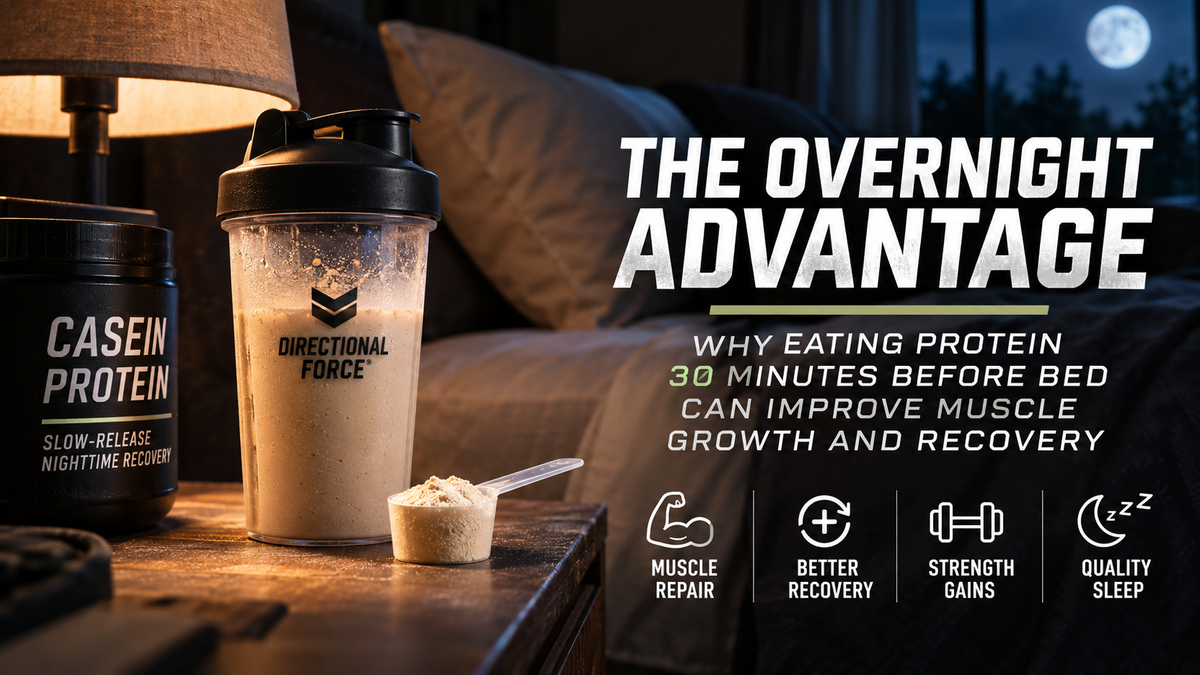
Your workout may be over, but your muscles are still working. Here's how a simple nighttime nutrition strategy could help you recover, rebuild, and get more out of every training session.
You've put in the work. You've completed your strength training, pushed through your conditioning, and challenged your body to become stronger.
But what happens when your head hits the pillow?
For many athletes, sleep is simply a time to rest. In reality, it's also a critical period for muscle repair, recovery, and adaptation.
And emerging research suggests that what you eat shortly before bed could influence how effectively your body uses those overnight hours.
One particularly promising strategy is consuming 30–40 grams of high-quality protein approximately 30 minutes before going to sleep.
The science behind this approach centers on muscle protein synthesis, the process your body uses to repair and build muscle tissue.
And when it comes to nighttime protein, one type stands out: casein protein.
1. Your Muscles Don't Stop Recovering When You Fall Asleep
Every challenging workout creates a stimulus for your muscles to adapt.
Resistance training places mechanical stress on muscle fibers, triggering cellular processes that can lead to stronger, more developed muscle tissue.
But training is only part of the equation.
Your body also needs sufficient amino acids, the building blocks of protein, to support muscle protein synthesis.
During sleep, your body continues repairing and remodeling muscle tissue. However, going an extended period without eating means fewer dietary amino acids are entering your bloodstream.
This is where pre-sleep protein becomes interesting.
Research indicates that consuming protein before bed can increase the availability of amino acids throughout the night, supporting overnight muscle protein synthesis.
The takeaway: Your recovery doesn't end when your workout ends. Providing your body with protein before sleep may help support the rebuilding process while you rest.
2. Why Casein Protein Is Particularly Effective Before Bed
Not all proteins digest at the same rate.
Whey protein is generally considered fast-digesting, making it popular immediately after workouts.
Casein, on the other hand, digests more slowly.
When casein reaches the stomach, it forms a gel-like clot that slows gastric emptying and the release of amino acids into the bloodstream.
This creates a more gradual delivery of amino acids over several hours.
That's exactly why casein is frequently studied as a pre-sleep protein source.
Whey vs. Casein: What's the Difference?
| Whey Protein | Casein Protein |
|---|---|
| Relatively fast digestion | Slower digestion |
| Rapid rise in circulating amino acids | More prolonged amino acid availability |
| Popular after workouts | Particularly useful before bed |
| Rich in essential amino acids | Rich in essential amino acids |
Both are complete, high-quality proteins.
However, casein's slower digestion makes it a practical choice for providing amino acids during an extended overnight period without food.
Important distinction: Casein isn't necessarily superior to whey for overall muscle growth. Total daily protein intake, training quality, and consistency remain more important than the specific type of protein consumed before bed.
3. What the Science Says About Protein Before Sleep
Several published studies have investigated whether consuming protein before bed can support overnight muscle recovery and long-term training adaptations.
Study #1: Protein Before Sleep Increases Overnight Muscle Protein Synthesis
A landmark 2012 study published in Medicine & Science in Sports & Exercise examined protein consumption before sleep following evening resistance exercise.
Researchers provided participants with 40 grams of casein protein approximately 30 minutes before bedtime.
They found that the protein was effectively digested and absorbed during sleep, increasing overnight muscle protein synthesis compared with a placebo.
The findings demonstrated that the body can utilize dietary protein during sleep to support muscle recovery.
What it means: Consuming protein before bed can provide amino acids that your muscles use during the overnight recovery period.
Study #2: Pre-Sleep Protein May Improve Long-Term Strength and Muscle Gains
A 2015 study published in The Journal of Nutrition followed young men participating in a 12-week resistance training program.
One group consumed a pre-sleep supplement containing approximately 27.5 grams of protein, while the control group received a non-protein placebo.
The pre-sleep protein group experienced greater improvements in muscle size and strength.
These results suggest that nighttime protein supplementation may enhance training adaptations over time.
However, because the protein group also consumed more total daily protein, the study cannot establish that bedtime timing alone caused the additional gains.
Study #3: Pre-Sleep Protein Is a Practical Recovery Strategy
A 2019 review published in Frontiers in Nutrition examined research on protein ingestion before sleep.
The authors concluded that approximately 30–40 grams of casein before bed can increase overnight muscle protein synthesis, particularly after resistance exercise.
The review also noted that pre-sleep protein may support training adaptations without necessarily interfering with overnight fat metabolism.
The research-supported conclusion: Pre-sleep protein can increase overnight muscle protein synthesis. Its additional long-term benefits depend on factors such as total daily protein intake, training, and whether the bedtime serving provides protein that would otherwise be missing from the diet.
4. Six Potential Benefits of Consuming Protein Before Bed
Benefit #1: Supports Overnight Muscle Repair
Resistance training challenges muscle tissue and stimulates the processes responsible for adaptation.
Consuming protein before bed provides essential amino acids that support muscle protein synthesis during the overnight recovery period.
This can be particularly useful following demanding strength workouts.
Benefit #2: May Help Maximize Muscle Growth
Building muscle requires a combination of progressive resistance training, sufficient calories, and adequate protein.
Pre-sleep protein offers another opportunity to stimulate muscle protein synthesis.
For individuals who struggle to consume enough protein during the day, adding a nighttime serving can be an effective strategy.
Benefit #3: Supports Strength Development
Muscle strength improves through repeated training and recovery.
Some research suggests that pre-sleep protein supplementation can enhance strength gains during structured resistance training programs.
However, the benefit is likely greatest when the additional serving helps someone meet their overall protein needs.
Benefit #4: Helps Preserve Muscle During Aging
Maintaining muscle becomes increasingly important as we age.
Age-related muscle loss, known as sarcopenia, can negatively affect strength, mobility, balance, and metabolic health.
Older adults may also experience anabolic resistance, meaning their muscles respond less efficiently to smaller protein servings.
Consuming adequate amounts of high-quality protein throughout the day, potentially including a pre-sleep serving, may help support muscle maintenance.
For adults over 40 or 50 who train regularly, this can be a useful addition to a broader strength and nutrition program.
Benefit #5: May Support Muscle Retention During Weight Loss
When you're in a calorie deficit, the goal is often to lose body fat while maintaining lean muscle.
Resistance training and sufficient daily protein are two of the most important tools for preserving muscle during weight loss.
A pre-sleep protein serving may make it easier to meet daily protein targets while providing amino acids overnight.
However, nighttime protein is not a special fat-burning strategy. The calories still count toward your daily intake.
Benefit #6: Makes Daily Protein Goals Easier to Achieve
This may be the most practical benefit of all.
Many active adults struggle to consume sufficient protein consistently.
Instead of forcing large amounts of protein into two or three meals, distributing intake across the day can make nutrition easier to manage.
A nighttime serving of 30–40 grams provides an additional opportunity to reach your target without dramatically increasing meal sizes.
5. How Much Protein Should You Consume Before Bed?
Research frequently uses approximately 30–40 grams of protein before sleep, particularly casein.
For most healthy adults who regularly perform resistance training, this is a reasonable starting range.
The exact amount should depend on body size, age, training intensity, and total daily protein consumption.
A Practical Protein Guide
| Goal | Suggested Pre-Sleep Protein |
|---|---|
| General recovery | 25–30 grams |
| Muscle building | 30–40 grams |
| Heavy resistance training | 30–40 grams |
| Healthy aging and muscle maintenance | 30–40 grams |
| Fat loss with muscle preservation | 25–40 grams, within calorie targets |
These are practical ranges, not guarantees of additional results. Individual needs vary, and the most important consideration is meeting your overall daily protein target.
For many active adults, a daily intake of approximately 1.4–2.0 grams of protein per kilogram of body weight is a useful evidence-based range, with some individuals benefiting from higher amounts depending on their training and energy intake.
6. Why 30 Minutes Before Bed?
The 30-minute window comes from research protocols in which participants consumed protein shortly before going to sleep.
But there's an important point:
Thirty minutes is a convenient guideline, not a scientifically established magic window.
You don't need to watch the clock.
Consuming protein approximately 30–60 minutes before bed is a practical approach. The most important factors are consuming an appropriate amount of high-quality protein, meeting your daily nutritional needs, and maintaining good sleep quality.
If a large shake makes you uncomfortable or causes nighttime reflux, consuming it earlier may be preferable.
7. The Best Foods to Eat Before Bed for Muscle Recovery
You don't necessarily need supplements to take advantage of nighttime protein.
Several everyday foods provide high-quality protein, including casein.
Option 1: Casein Protein Shake
Protein: Approximately 30–40 grams, depending on the serving.
Mix casein powder with water or milk according to the product's nutrition label.
This is one of the most convenient options and closely resembles the approach used in several research studies.
Option 2: Cottage Cheese
Protein: Approximately 25–28 grams per cup, depending on the brand.
Cottage cheese naturally contains casein protein.
It's an excellent whole-food option for people who prefer not to use supplements.
Pair it with berries or cinnamon for flavor.
Option 3: Plain Greek Yogurt
Protein: Approximately 15–25 grams per serving, depending on portion size and brand.
Greek yogurt provides a combination of milk proteins, including casein.
Choose a higher-protein variety, and adjust the serving to fit your daily protein target.
Option 4: Skyr
Protein: Approximately 15–20 grams per typical serving, depending on the brand.
This thick, strained dairy product is another convenient source of high-quality protein.
Option 5: Milk-Based Protein Smoothie
Combine milk with casein protein powder for an easy nighttime shake.
You can also add berries or a small amount of nut butter, depending on your calorie needs.
Remember: You don't have to consume casein specifically. Other complete proteins can contribute to your daily needs, even though casein has the strongest direct research base for pre-sleep supplementation.
8. How to Implement Pre-Sleep Protein Into Your Routine
The best nutrition strategy is one you can follow consistently.
Here's a simple approach.
Step 1: Calculate your daily protein goal.
For example, a 180-pound adult weighs approximately 82 kilograms.
At 1.6 grams of protein per kilogram, that works out to approximately 131 grams of protein daily.
Step 2: Spread your protein throughout the day.
Instead of consuming most of your protein at dinner, aim for several protein-containing meals.
For example:
-
Breakfast: 30 grams
-
Lunch: 35 grams
-
Dinner: 35 grams
-
Before bed: 30 grams
Total: 130 grams of protein.
Step 3: Choose your nighttime protein source.
Casein powder, cottage cheese, Greek yogurt, or another high-quality protein source can work.
Step 4: Consume it shortly before bed.
Start approximately 30–60 minutes before going to sleep, adjusting for digestive comfort.
Step 5: Prioritize quality sleep.
Protein supplementation cannot compensate for consistently inadequate sleep.
Aim for approximately 7–9 hours of sleep per night as an adult, while recognizing individual needs vary.
Step 6: Stay consistent with resistance training.
Your muscles need a reason to adapt.
Progressive strength training, adequate nutrition, and recovery work together to produce results.

9. Does Eating Protein Before Bed Cause Weight Gain?
One of the most common concerns about eating before bed is whether nighttime calories automatically become body fat.
They don't.
Weight gain is primarily influenced by overall energy balance over time, not simply the hour at which food is consumed.
If a pre-sleep protein shake fits within your daily calorie needs, consuming it at night does not automatically cause fat gain.
In fact, pre-sleep protein can be incorporated into both muscle-building and fat-loss nutrition plans.
The key is to account for those calories as part of your total daily intake.
10. Who Should Consider Pre-Sleep Protein?
This strategy may be particularly useful for:
-
Strength athletes and weightlifters seeking to support muscle recovery and growth.
-
Adults over 40 focused on maintaining muscle mass and functional strength.
-
Athletes performing demanding conditioning who need sufficient protein to recover from training.
-
Individuals losing body fat who want to maintain muscle while controlling calorie intake.
-
Busy professionals who have difficulty meeting protein targets during the day.
However, more protein isn't always better.
People with kidney disease, medically prescribed protein restrictions, or other conditions affecting protein metabolism should consult their healthcare professional before significantly increasing protein intake.
Individuals with dairy allergies or lactose intolerance should also choose appropriate alternatives.
The Directional Force Perspective: Train Hard. Recover Smarter.
At Directional Force, we believe performance is built through more than what happens during a workout.
Strength, endurance, and resilience are developed through the combination of intelligent training, proper nutrition, and consistent recovery.
Whether you're training with a weighted vest, pushing through a demanding strength session, or working to maintain muscle and mobility as you age, what you do outside the gym matters just as much as the work you put in.
Proper nutrition fuels recovery. Consistent training gives your body a reason to adapt. And quality sleep provides the opportunity to rebuild, recover, and come back stronger.
That's the philosophy behind our Run-Ruck-Lift-Live Collection — gear designed to support an active lifestyle, challenge your limits, and help you pursue better performance at every stage of life.
Explore the Directional Force Run-Ruck-Lift-Live Collection
Because lasting performance isn't simply about how hard you train. It's about how consistently you show up, how intelligently you recover, and the habits you build along the way.
Sometimes, improving performance doesn't require another workout. It requires making better use of the recovery time you already have.
Train with purpose. Fuel your recovery. Build strength that lasts.
Directional Force | Force Multiplier Magazine
Disclaimer: This is for informational purposes only and is not medical advice. Consult a healthcare provider before making significant changes to sodium or fluid intake, especially if you have high blood pressure, kidney disease, or other medical conditions. Individual needs vary widely based on sweat rate, climate, training load, and health status.
Consult your physician before starting any peptide or supplement and making any dietary changes, etc. Consult a fitness professional before starting any new workout, especially if you have pre-existing injuries. Listen to your body and adjust weights or reps as needed. Always consult a healthcare provider before starting any workout program, physical activity, or taking any supplement to make sure that you're healthy enough.
The content contained in this article is for information purposes only, and is not meant to be a substitute or replacement for professional advice and medical consultation. It is just shared as information only, and with the understanding that Directional Force, LLC, (Directional Force) is not engaged in the provision or rendering of medical advice or services whatsoever. You unilaterally understand and agree that Directional Force shall not be liable for any claim, loss, or damage arising out of the use of, or reliance upon any content or information in this article or any article provided by Directional Force. Please seek professional medical advice prior to engaging in, or undertaking any of the content, exercises, advice, and workouts provided by Directional Force.