
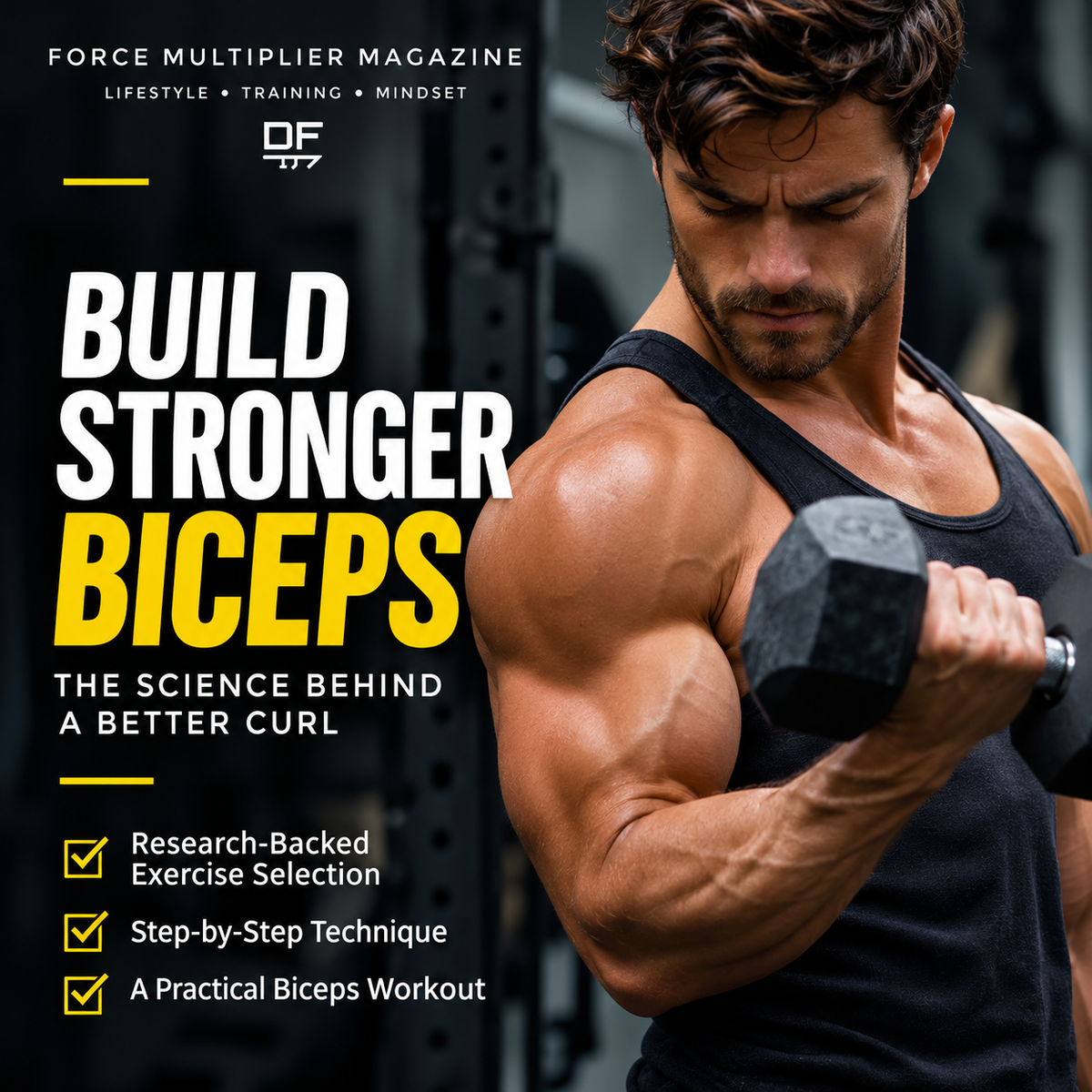
Force Multiplier Magazine | Directional Force
Building stronger arms starts with understanding how you train them. The position of your upper arm, your grip, and the direction of resistance all change the demands of a curl.
Jeff Nippard explores these differences in his biceps exercise breakdowns, combining published research with biomechanics and training experience. His rankings highlight options such as preacher curls and face-away Bayesian cable curls. Those rankings are useful exercise-selection tools, but they should be distinguished from controlled research comparing muscle growth.
Here is how to apply those ideas to a practical biceps workout.
Understand What Makes a Curl Different
Your biceps help bend your elbow and rotate your forearm into a palm-up position, a movement called supination. Because the biceps also cross the shoulder, moving your upper arm behind your torso lengthens them at the shoulder.
However, a bigger stretch does not automatically mean a harder exercise.
With dumbbells, the external turning force around your elbow depends on how far the weight sits horizontally from the joint. When your forearm hangs vertically, that turning force is low. As it approaches horizontal, the demand increases.
Cables change the direction of the pull. Adjusting the pulley and your position can therefore change where a curl becomes difficult. A cable provides resistance, but it does not automatically create constant tension at the elbow throughout every repetition. The setup matters. Research comparing preacher and Bayesian curls has explicitly controlled these resistance profiles to separate them from shoulder position.
What Does the Research Actually Show?
There is good reason to use different curl variations, but the evidence does not establish one universal winner.
A 2025 study involving 15 untrained young men compared cable preacher curls with Bayesian curls over 10 weeks. When resistance profiles were matched, researchers found similar muscle growth, with no statistically significant differences between exercises at the measured sites.
A 2026 study involving 21 untrained adults compared incline and preacher dumbbell curls over 12 weeks. Incline curls produced more biceps brachii growth, while preacher curls produced more growth in the brachialis and brachioradialis. Total elbow-flexor growth did not differ significantly.
Our practical takeaway: combine exercises you can perform comfortably and progress consistently. Different setups offer useful options; a single ranking cannot account for every lifter.
The Force Multiplier Biceps Workout
This is our suggested routine, informed by those principles. It is not a reproduction of Nippard’s program.
| Exercise | Working sets | Repetitions | Rest |
|---|---|---|---|
| Dumbbell preacher curl | 2 | 8–12 | 90–120 seconds |
| Single-arm Bayesian cable curl | 2 per arm | 10–15 | 90–120 seconds before repeating the same arm |
| Dumbbell hammer curl | 2 | 10–15 | 90 seconds |
Begin with one or two light preparation sets. Choose working weights that leave approximately one or two clean repetitions available at the end of each set.
Start with this workout once weekly alongside your pulling exercises. Add a second session only if your recovery and existing training volume support it, leaving at least 48 hours between direct biceps sessions.
1. Dumbbell Preacher Curl
Why include it: The pad supports your upper arm and makes swinging more difficult. An angled upper arm also changes the dumbbell’s resistance profile compared with a standing curl.
How to do it:
-
Adjust the seat so your upper arm rests comfortably against the preacher pad.
-
Hold a dumbbell with your palm facing up and your wrist aligned with your forearm.
-
Keep your upper arm in contact with the pad as you lower the weight.
-
Extend your elbow through a comfortable range without forcing it into hyperextension.
-
Curl the dumbbell upward without lifting your shoulder or pulling your arm off the pad.
-
Lower smoothly, taking roughly two seconds.
Coaching cue: Keep your upper arm supported and make each repetition look the same.
Common mistake: Bouncing out of the bottom. Use a load you can reverse under control.
2. Single-Arm Bayesian Cable Curl
Why include it: Positioning your upper arm behind your torso lengthens the biceps at the shoulder. The cable lets you apply resistance from behind rather than relying on gravity alone.
How to do it:
-
Attach a single handle to an adjustable cable pulley.
-
Start with the pulley around hand height when your arm is lowered; adjust for your proportions.
-
Face away from the machine and step forward into a stable, staggered stance.
-
Let your upper arm sit slightly behind your torso, with your palm facing forward.
-
Curl the handle by bending your elbow while keeping your upper arm relatively still.
-
Lower until your elbow is comfortably extended, maintaining control.
Coaching cue: Find a comfortable stretch you can control. A small amount of shoulder extension is enough.
Common mistake: Stepping so far forward that the cable pulls your shoulder into an uncomfortable position. Reduce the distance or adjust the pulley.
3. Dumbbell Hammer Curl
Why include it: A neutral grip adds another way to train the elbow flexors, including the brachialis and brachioradialis. Your biceps still contribute.
How to do it:
-
Stand tall with a dumbbell in each hand and your palms facing inward.
-
Keep your elbows near your sides and your wrists straight.
-
Curl both dumbbells upward with your thumbs leading.
-
Stop before you need to swing or drive your elbows forward.
-
Lower until your arms are comfortably extended.
Coaching cue: Move the dumbbells with your arms while keeping your torso steady.
Common mistake: Choosing weights that require hip drive to finish every repetition.
Training With Dumbbells Only?
Replace the Bayesian cable curl with an incline dumbbell curl.
Set an adjustable bench to approximately 45–60 degrees, support your back, and allow your arms to hang naturally. Curl with your palms facing up, keeping your shoulders comfortable and your upper arms relatively still.
This places the upper arm behind the torso, but it does not reproduce the cable’s resistance profile. Choose the bench angle that lets you move smoothly without shoulder discomfort.
Make Progress You Can Measure
Keep the same exercises and setups long enough to track improvement.
For an exercise prescribed at 8–12 repetitions, start with a weight you can lift for at least eight controlled reps. When you reach 12 on both working sets with the same technique and effort, increase the load by the smallest available increment.
For single-arm exercises, begin with your weaker side and match its repetitions with your stronger side.
A heavier dumbbell only represents progress if you can still perform the movement you intended to train.
Avoid These Common Biceps Training Mistakes
-
Changing exercises every workout: Consistency makes progress easier to measure.
-
Rushing the lowering phase: Lower with control instead of dropping the weight.
-
Forcing a stretch: Use a comfortable range; stop or adjust movements that cause sharp pain.
-
Adding sets without considering back training: Rows, pulldowns, and chin-ups already involve your elbow flexors.
-
Expecting an exercise to guarantee a specific biceps shape: Focus on developing muscle rather than promises about a perfect peak.
The Directional Force Perspective: Train With Purpose
At Directional Force, we believe every movement should earn its place in your training.
Choose exercises you can control. Build strength through repeatable technique. Support the work with adequate nutrition, sleep, and recovery.
Stronger arms are built one quality repetition—and one consistent session—at a time.
Run - Ruck - Lift - Live

Disclaimer: This is for informational purposes only and is not medical advice. Consult a healthcare provider before making significant changes to sodium or fluid intake, especially if you have high blood pressure, kidney disease, or other medical conditions. Individual needs vary widely based on sweat rate, climate, training load, and health status.
Consult your physician before starting any peptide or supplement and making any dietary changes, etc. Consult a fitness professional before starting any new workout, especially if you have pre-existing injuries. Listen to your body and adjust weights or reps as needed. Always consult a healthcare provider before starting any workout program, physical activity, or taking any supplement to make sure that you're healthy enough.
The content contained in this article is for information purposes only, and is not meant to be a substitute or replacement for professional advice and medical consultation. It is just shared as information only, and with the understanding that Directional Force, LLC, (Directional Force) is not engaged in the provision or rendering of medical advice or services whatsoever. You unilaterally understand and agree that Directional Force shall not be liable for any claim, loss, or damage arising out of the use of, or reliance upon any content or information in this article or any article provided by Directional Force. Please seek professional medical advice prior to engaging in, or undertaking any of the content, exercises, advice, and workouts provided by Directional Force.