
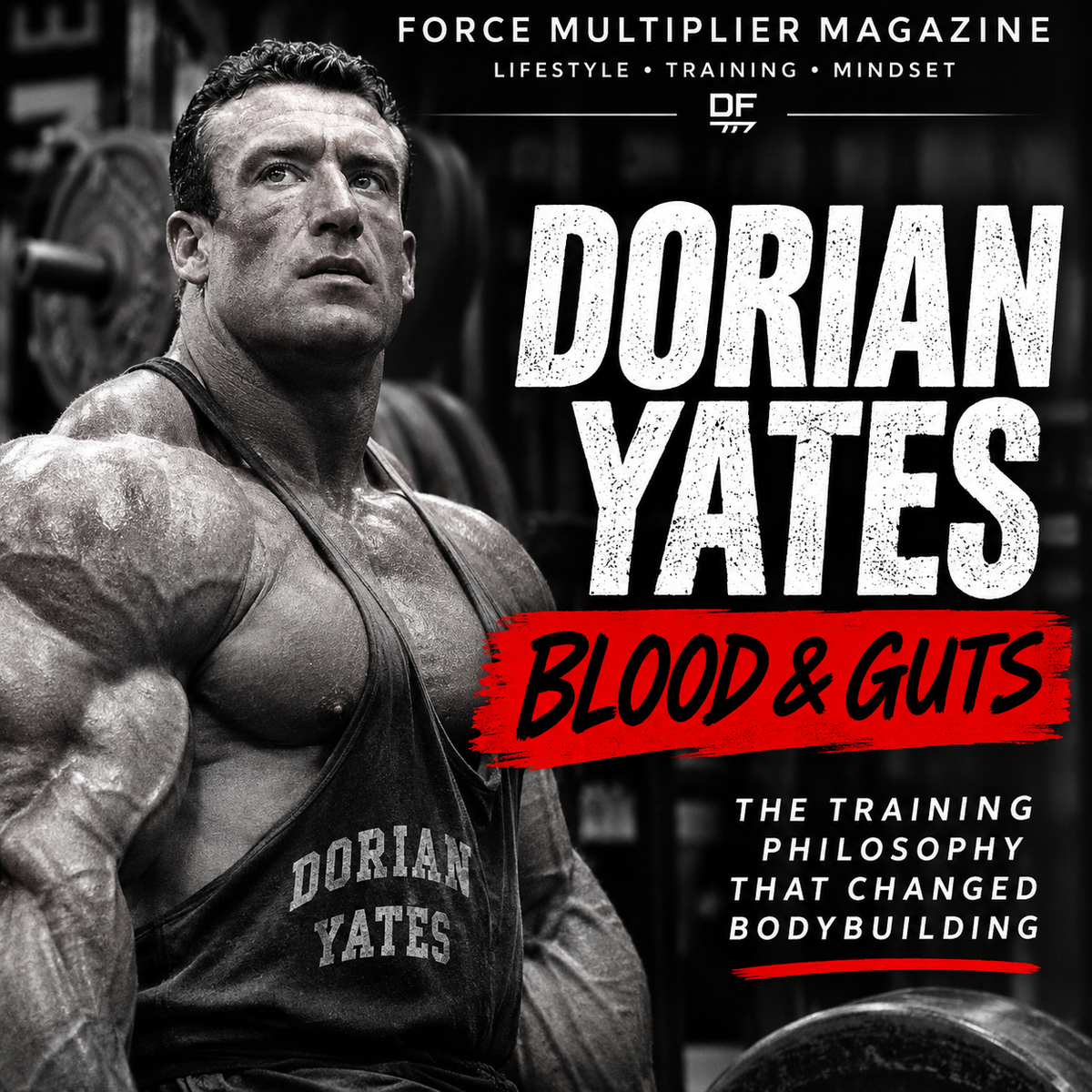
Six Mr. Olympia titles. Relentless intensity. Uncompromising discipline. How Dorian Yates redefined muscle building by proving that more time in the gym doesn't necessarily mean better results.
In the world of bodybuilding, few names command the respect of Dorian Yates.
Known as The Shadow, the British bodybuilder dominated professional bodybuilding throughout the 1990s, winning six consecutive Mr. Olympia titles from 1992 through 1997.
But what made Yates extraordinary wasn't simply his size, conditioning, or muscular development. It was his approach to training.
While many of his competitors spent hours in the gym performing endless sets, Yates pursued a different philosophy: train with maximum intensity, minimize unnecessary volume, and allow the body sufficient time to recover and grow.
His legendary Blood and Guts training system became one of bodybuilding's most recognizable approaches.
And its foundation can be traced, in part, to another revolutionary figure in strength training: Mike Mentzer.
The Mike Mentzer Influence: High-Intensity Training
Before Dorian Yates became a bodybuilding legend, Mike Mentzer had already challenged conventional training wisdom.
Mentzer was an advocate of High-Intensity Training (HIT), a philosophy influenced by Arthur Jones, the inventor of Nautilus exercise machines.
The central premise was relatively straightforward:
Muscle growth requires a sufficiently demanding training stimulus, but the adaptation occurs during recovery.
Mentzer believed that many bodybuilders performed far more training volume than necessary, potentially interfering with recovery and progress.
His Heavy Duty training philosophy emphasized:
-
Brief, highly demanding workouts.
-
A limited number of working sets.
-
Training to momentary muscular failure.
-
Progressive overload through increased strength and performance.
-
Sufficient recovery between training sessions.
Yates studied Mentzer's ideas and incorporated many of these principles into his own training.
However, he didn't simply copy Mentzer's methods.
He refined them through years of experimentation, developing a system that combined low-volume training, carefully selected exercises, progressive overload, and extraordinary effort.
The result was his famous Blood and Guts training philosophy.
Blood and Guts: One Set That Matters
Perhaps the most misunderstood aspect of Dorian Yates' training was his emphasis on performing just one all-out working set per exercise.
That doesn't mean he walked into the gym, loaded a barbell with maximum weight, and immediately trained to failure.
Quite the opposite.
Yates understood the importance of preparation.
For demanding compound exercises, he typically performed several progressively heavier warm-up sets before reaching his maximum working weight.
These warm-up sets prepared his muscles, joints, and nervous system without unnecessarily exhausting him.
Then came the working set.
One brutally demanding set performed with controlled technique, heavy resistance, and complete concentration.
Yates frequently trained to momentary muscular failure, the point at which another complete repetition could no longer be performed with proper technique.
At certain points in his career, he also incorporated advanced intensity techniques, including forced repetitions, partial repetitions, and negatives.
These methods pushed muscular fatigue beyond conventional failure.
But Yates' approach wasn't simply about lifting heavy weights.
It was about maximizing the effectiveness of every repetition.
The principles behind Blood and Guts
1. Intensity over volume
Instead of performing four or five hard working sets for every exercise, Yates concentrated his effort into one exceptionally demanding working set after warming up.
2. Progressive overload
Strength progression was central to his philosophy. When he could complete more repetitions with a given weight, he aimed to increase the resistance while maintaining proper technique.
3. Controlled execution
Yates emphasized maintaining muscular tension, controlling the lowering phase, and avoiding unnecessary momentum.
4. Exercise selection
He combined free weights with machines and cables, choosing movements that allowed him to train specific muscles effectively and progressively.
5. Recovery as part of training
Yates understood that training provides the stimulus, while adequate nutrition, sleep, and recovery support the adaptation.
His workouts were intense, but relatively brief.
The goal wasn't to spend the most time in the gym.
The goal was to make the time spent training count.
The Dorian Yates Workout Split
One of the defining characteristics of Yates' training was his four-day split.
Rather than training every muscle multiple times per week, his classic approach divided the body into four demanding sessions, with recovery days strategically placed throughout the week.
The Classic Blood and Guts Split
| Day | Muscle Groups |
|---|---|
| Monday | Shoulders, Triceps, Abs |
| Tuesday | Back, Rear Delts |
| Wednesday | Rest |
| Thursday | Chest, Biceps |
| Friday | Rest |
| Saturday | Legs |
| Sunday | Rest |
This arrangement allowed Yates to train individual muscle groups with tremendous intensity while providing several days of recovery before repeating the cycle.
His exact exercise selections and training schedules evolved throughout his career. The following workouts reflect a commonly documented version of his Blood and Guts routine.
Important: The sets listed below represent primary working sets. Yates also performed progressively heavier warm-up sets, particularly before demanding exercises.
Day 1: Shoulders, Triceps, and Abs
Yates developed exceptionally thick deltoids and powerful triceps using a combination of presses, isolation movements, and controlled repetitions.
| Exercise | Working Sets | Rep Range |
|---|---|---|
| Smith Machine Shoulder Press | 1 | 6–8 |
| Dumbbell Lateral Raises | 1 | 8–10 |
| One-Arm Cable Lateral Raises | 1 | 8–10 |
| Dumbbell Shrugs | 1 | 10–12 |
| Cable Triceps Pushdowns | 1 | 10–12 |
| Lying EZ-Bar Triceps Extensions | 1 | 8–10 |
| One-Arm Dumbbell Triceps Extensions | 1 | 8–10 |
| Crunches | 1 | 15–20 |
| Reverse Crunches | 1 | 15–20 |
Yates emphasized strict form and targeted muscular contraction rather than simply moving the heaviest possible weight.
Day 2: Back and Rear Delts
If one body part defined Dorian Yates' physique, it was his back.
His combination of width, thickness, and muscular detail established a new standard for professional bodybuilding.
His back training incorporated pulldowns, rows, and heavy pulling movements to develop the entire posterior chain.
| Exercise | Working Sets | Rep Range |
|---|---|---|
| Nautilus Pullover | 1 | 8–10 |
| Underhand-Grip Pulldown | 1 | 8–10 |
| Barbell Rows | 1 | 6–8 |
| One-Arm Hammer Strength Rows | 1 | 8–10 |
| Cable Rear-Delt Flyes | 1 | 8–10 |
| Bent-Over Dumbbell Rear-Delt Raises | 1 | 8–10 |
| Back Extensions | 1 | 10–12 |
| Deadlifts | 1 | 6–8 |
Yates became particularly famous for his underhand barbell rows, often called Yates Rows.
Unlike traditional bent-over rows performed with the torso nearly parallel to the floor, Yates used a more upright torso position and pulled the bar toward his lower abdomen.
This movement became synonymous with his approach to developing back thickness.
Day 3: Chest and Biceps
Yates approached chest and biceps training with the same philosophy: carefully selected movements, controlled repetitions, and limited but demanding working sets.
| Exercise | Working Sets | Rep Range |
|---|---|---|
| Incline Barbell Press | 1 | 6–8 |
| Hammer Strength Chest Press | 1 | 6–8 |
| Incline Dumbbell Flyes | 1 | 8–10 |
| Cable Crossovers | 1 | 10–12 |
| Incline Dumbbell Curls | 1 | 6–8 |
| EZ-Bar Curls | 1 | 6–8 |
| Nautilus or Machine Curls | 1 | 6–8 |
Yates often favored incline pressing movements to emphasize upper-chest development.
For biceps, he emphasized controlled execution, avoiding excessive swinging or momentum.
Day 4: Legs
Yates' leg training was demanding, combining heavy compound movements with targeted isolation exercises.
His approach frequently included pre-exhaustion, where an isolation movement was performed before a compound exercise.
For example, leg extensions could fatigue the quadriceps before leg presses or squats.
| Exercise | Working Sets | Rep Range |
|---|---|---|
| Leg Extensions | 1 | 10–12 |
| Leg Press | 1 | 10–12 |
| Hack Squats | 1 | 6–8 |
| Lying Leg Curls | 1 | 6–8 |
| Stiff-Leg Deadlifts | 1 | 8–10 |
| Standing Calf Raises | 1 | 10–12 |
| Seated Calf Raises | 1 | 10–12 |
Yates' leg workouts were exceptionally demanding because he applied his high-intensity philosophy to large muscle groups capable of handling substantial resistance.
A note on these routines: They are historical examples of Yates' training, not beginner prescriptions. Training to absolute failure on heavy compound exercises can significantly increase fatigue and the consequences of technical breakdown.
Rep Ranges: Why Yates Trained Heavy
Yates generally favored moderate repetition ranges, frequently using approximately six to eight repetitions for heavy compound exercises and eight to twelve for many isolation movements.
His exact repetition targets varied by exercise and training period.
He believed that using sufficiently heavy resistance while maintaining controlled execution was essential for building muscle.
However, Yates didn't simply chase heavier weights at the expense of technique.
He focused on creating mechanical tension within the target muscle.
A typical progression might look like this:
Week 1: 225 pounds for 6 repetitions.
Week 2: 225 pounds for 7 repetitions.
Week 3: 225 pounds for 8 repetitions.
Week 4: Increase the resistance slightly and begin progressing again.
This is an example of double progression, a practical way to apply progressive overload.
The underlying lesson remains relevant today:
Track your performance. Improve your execution. Gradually increase the demands placed on your muscles.
The Science: Does High-Intensity, Low-Volume Training Work?
Modern exercise science supports several important elements of Yates' philosophy.
Progressive resistance training, sufficient mechanical tension, and adequate recovery are all important contributors to muscular development.
Research also suggests that training close to muscular failure can effectively stimulate hypertrophy.
However, there is an important distinction between training close to failure and taking every set to complete muscular failure.
Research does not consistently demonstrate that absolute failure is necessary for maximizing muscle growth.
Additionally, studies examining resistance-training volume generally indicate that performing multiple challenging sets per muscle group each week can produce greater hypertrophy than very low training volumes, although the relationship varies among individuals.
This means Yates' approach should be viewed in context.
His results demonstrate what an exceptionally gifted, highly experienced professional bodybuilder achieved using his particular system.
They do not establish that one working set per exercise is universally optimal.
Nevertheless, his emphasis on purposeful training, progressive overload, and avoiding unnecessary volume remains valuable.
What the research tells us
A 2017 systematic review and meta-analysis by Schoenfeld and colleagues found a dose-response relationship between weekly resistance-training volume and muscle growth.
A 2023 meta-analysis by Grgic and colleagues found that training to momentary muscular failure was not clearly superior to non-failure training for hypertrophy.
Together, these findings suggest that hard, productive training matters, but additional volume and recovery must be balanced according to individual needs.
For most recreational lifters, a sustainable program that combines sufficient weekly training volume with challenging sets performed close to failure may be more practical than copying Yates' most extreme training methods.
The Cost of Extreme Intensity
Yates' career also illustrates the physical demands of consistently training at the highest levels.
He experienced serious injuries, including a torn biceps and triceps injuries, during his competitive career.
These injuries cannot be attributed to a single training principle, but they serve as a reminder that extremely heavy training and advanced failure techniques carry risks.
For everyday athletes, especially those balancing strength training with running, rucking, occupational demands, and other activities, managing fatigue is essential.
A practical adaptation of Yates' philosophy might include:
-
Two or three progressively heavier warm-up sets before demanding compound exercises.
-
One or two challenging working sets per exercise initially, adjusted according to weekly volume and progress.
-
Most working sets ending approximately one to three repetitions short of failure.
-
Occasional failure training on lower-risk isolation exercises.
-
Consistent performance tracking and adequate recovery between sessions.
The objective should be long-term progression, not exhaustion for its own sake.
The Directional Force Perspective: Train With Purpose. Recover With Discipline.
At Directional Force, we believe effective training is built on discipline, consistency, and intelligent progression.
Dorian Yates' philosophy reinforces an important principle: more isn't always better. Better is better.
Whether you're building muscle in the gym, improving endurance through weighted-vest training, or preparing for demanding physical challenges, every workout should have a purpose.
Strength training provides the foundation for muscular development.
Walking, running, and rucking can support cardiovascular fitness, muscular endurance, and overall conditioning.
But the key is understanding how these activities work together.
A demanding lower-body session followed immediately by an unnecessarily strenuous weighted ruck may interfere with recovery.
Conversely, a controlled walk or appropriately programmed low-intensity conditioning session can complement a structured resistance-training program.
The lesson from Yates isn't that everyone should train to absolute failure.
It's that training should be deliberate.
Choose your exercises carefully.
Execute every repetition with purpose.
Track your progress.
Fuel your body properly.
Respect recovery.
And above all, remain consistent.
Run. Ruck. Lift. Live.
The Legacy of Dorian Yates
Dorian Yates didn't become a six-time Mr. Olympia champion by following the crowd.
He questioned conventional training practices, studied the philosophies of those who came before him, and developed a system suited to his body and competitive goals.
Mike Mentzer helped establish the intellectual foundation for high-intensity training.
Yates transformed many of those ideas into one of bodybuilding's most recognizable training systems.
His legacy extends beyond championship trophies.
He demonstrated that effective training isn't measured simply by the number of exercises performed, sets completed, or hours spent in the gym.
It's measured by the quality of the stimulus, the ability to recover, and the progress achieved over time.
For anyone serious about strength, muscle development, and long-term physical performance, that remains a lesson worth remembering.
Train hard. Train intelligently. Recover completely. Repeat.
Go Deeper: Dorian Yates' Blood and Guts
For those interested in exploring Dorian Yates' training philosophy firsthand, his autobiography A Warriors Story offers a deeper look into the mindset, discipline, and high-intensity training methods that helped him become a six-time Mr. Olympia champion.
It's a worthwhile read for bodybuilding enthusiasts and anyone interested in understanding the philosophy behind one of the most formidable physiques in bodybuilding history.
References and Further Reading
-
Yates, D. Blood and Guts. Classic Dorian Yates training materials and instructional videos documenting his high-intensity training approach.
-
Mentzer, M. High-Intensity Training the Mike Mentzer Way. Contemporary Books, 2002.
-
Schoenfeld, B. J., Ogborn, D., & Krieger, J. W. (2017). "Dose-response relationship between weekly resistance training volume and increases in muscle mass: A systematic review and meta-analysis." Journal of Sports Sciences, 35(11), 1073–1082.
-
Grgic, J., et al. (2023). "Effects of resistance training performed to repetition failure or non-failure on muscular strength and hypertrophy: A systematic review and meta-analysis." Journal of Sport and Health Science.
-
American College of Sports Medicine. (2009). "Progression Models in Resistance Training for Healthy Adults." Medicine & Science in Sports & Exercise, 41(3), 687–708.
AI-generated editorial illustration of Dorian Yates.
Disclaimer: This is for informational purposes only and is not medical advice. Consult a healthcare provider before making significant changes to sodium or fluid intake, especially if you have high blood pressure, kidney disease, or other medical conditions. Individual needs vary widely based on sweat rate, climate, training load, and health status.
Consult your physician before starting any peptide or supplement and making any dietary changes, etc. Consult a fitness professional before starting any new workout, especially if you have pre-existing injuries. Listen to your body and adjust weights or reps as needed. Always consult a healthcare provider before starting any workout program, physical activity, or taking any supplement to make sure that you're healthy enough.
The content contained in this article is for information purposes only, and is not meant to be a substitute or replacement for professional advice and medical consultation. It is just shared as information only, and with the understanding that Directional Force, LLC, (Directional Force) is not engaged in the provision or rendering of medical advice or services whatsoever. You unilaterally understand and agree that Directional Force shall not be liable for any claim, loss, or damage arising out of the use of, or reliance upon any content or information in this article or any article provided by Directional Force. Please seek professional medical advice prior to engaging in, or undertaking any of the content, exercises, advice, and workouts provided by Directional Force.